
|

|
|
|
And now for the king of all injectors to date, the incredibly powerful, all electric, Powermatic 3. This Injector is all about Power. It takes a longer time to build and hence order times can slow down a bit but all that is about to change, as the maker is creating a new and separate factory that will be dedicated to the Powermatic 3 solely. This machine is everything anybody could want in an injector, and though it is electric, power is its only weakness. Now lack of power but availability of electricity itself. So during power outages, it won't function, but then so is the smaller Powermatic 2, and that fact has certainly not hurt its sales. Watch all the videos on this page and decide for yourself. The Powermatic 3 is quite a bit more expensive, but if speed, power and sheer performance is what you want. the Powermatic 3 is unmatched by any other injector on the planet.. It has a fillable hopper that holds more than a pack worth of tobacco, and once filled it produces sticks at an absolutely amazing rate. Perfect tight sticks. Loading the hopper is easy and requires only a slight stirring motion when filling. You then place a tube on the most easily accessible nozzle available anywhere, and push the start button. Less than a second later, you have a PERFECT cigarette. You can do up to 30 cigarettes without refilling the tobacco chamber you see under the brown plastic see-through lid at the left side of the machine. It beats the former world champ all electric Powermatic 2 in speed and in performance, but admittedly, the Powermatic 2 is still hard to beat and is less expensive. The new Powermatic 3 cost about 3 times that of the Powermatic 2. But for those that want sheer power and performance, the new Powermatic 3 is the champ. Both electrics, the Powermatic 2 and Powermatic 3, have both now taken electric injection to the ultimate. So it really is a matter of your budget as both will soon be available in sufficient quantity to satisfy the incredible demand for these machines. Our hats remain off to Zico, the maker of all the Powermatics for coming up with lasting designs worthy of everyone's respect. Any one of these 4 incredible machines, whether electric or manual, show what creativity, ingenuity and hard work can accomplish. This is the most impressive line of injectors we have ever seen, PERIOD! Again, watch all the videos below and judge for yourself. We pull no punches, these machines are nothing but pure magic,
And next in line, a couple of years later, came the Powermatic 150. This is the most sophisticated manual injector yet created. It is not as heavy as the Powermatic 1, but the transmission is far more sophisticated. It is more like an car's automatic transmission, with gear engagement and disengagement to allow it to lie perfectly flat for storage. The handle easily slips (out of gear) to release the crank lever so its extremely low profile can be set for storage in the most efficient, heavy cardboard box in the industry. Now the Powermatic 2 is such a marvelous machine and though much heavier is wonderful. Therefore at about the same price the 150 is a bit slow to catch on but our readers who have the 150 now, are very impressed. The injection cycle is silky smooth and requires less effort than even the larger Powermatic1. The action is so smooth that the effort to injector a cigarette is ostensibly effortless. And in long term 1 and a half years there has not been a single ripple in its performance. It does 100mm tubes as easily as it does typical length 84 mm tubes. You have to fill the chamber only a little tighter though and your 100 mm stick comes out perfect. And the ease of injection remain almost identical to the 84mm format. This is not my favorite manual injector and for several reasons. It's lighter and a bit more energy manageable, but the real killer is the superb box it comes in. No longer will you have to take apart a Styrofoam box and try to keep it together especially during transport of the machine. It is a one piece thick cardboard box with a flip down/up top that closes securely and stays that way. It again is my favorite injector for on the go and I highly recommend it.
August, 2013: Below we reviewed the Powermatic II from ZICO,
USA. It was and remains an evolutionary product and its popularity far exceeds
the expectations of most everyone who has used it. For a short while now these superb
electric machines have become a bit hard to find, again due to exceptionally high demand.
Well ZICO, USA, has just received another large shipment and though even
this large incoming
Now back to the Powermatic 1. I even prefer it to the Powermatic II as it
needs no electricity. My preference is not easily given as the Powermatic II will always
be at the top of my list of ultimate quality injectors. Perhaps it is just the fact that
electric power is not always available and I do smoke only outdoors and The Powermatic 1 which we have spent a couple of months now in intense testing is, without qualification, the finest manual machine we have ever seen. We will be writing much more about this new wonder from ZICO, USA in the coming days but we wanted you all to see it in action. Hence the video below which pretty much says it all. The machine needs no hype. There is nothing else to compare it to. And with a serious number of patents on it held by ZICO you are not going to see cheap-ass rip-offs. Everyone who has used it has been blown away. Remember that the typical crank injector like Supermatics and Top-O-Matics and their cheaper and smaller siblings use basically are built on 80 year old designs. The Powermatic 1 bears no resemblance to those old mechanical designs. Yes they did the job, some better than others but they all had many more weaknesses and are now (finally) old news. This is new stuff and it is simply incredible. Watch the video and be amazed. And remember the physical effort needed to use this machine is orders of magnitude less than any previous mechanical design and the sticks are as perfect as one could ever hope for. Because of its completely new design strategy, I've yet to find a way to break it without a hammer. Now like all injectors certain rules apply that you will find at the bottom of this page, especially cut and moisture content of the tobacco as well as the lack of foreign particles (sticks, stems, and other trash) one finds in cheap tobaccos However even these junk contents are more easily handled in this machine than any other I've seen in no small part due to the exceptionally sharp and strong Titanium cutter. No cheap stamped metal flat connecting arms to bend, no damn H-Link to go out of alignment, and no damn rivets to pop loose. Plus with the unidirectional T-Bar crank, there is not the slightest feeling of strain, either on your shoulders, arms or hands or on the crank itself. You hardly even have to hold it down with good tobacco. Like a Hurst T-Shifter on a classic Mopar muscle car. And the forged crank folds down when not in use. What a rush!!!! So here is the detailed video below. Click on the graphic below and prepare for the future. More to come on this jewel!
Now that you've seen the Powermatic 1 video (or even
before you watch it), Please
read this update: It is
important. First off and of less importance is that a few changes have come to the
Powermatic 1. Some strengthening of a couple of internal parts have occurred (I found them
unnecessary) though some very few people have had problems due to failure from what is The
second photo on the right shows that the newer version in full injection position stops
well short of the rubber bumper. This makes an The Injector - The Realities No consumer grade injector is designed for mass production at one sitting. We're talking about machines that cost about what a single carton of packaged cigarettes costs in many parts of the country and world. Making entire cartons at one sitting is not smart. First, the end product will over a short time begin to dry out and become harsh and you will lose that "freshness" component that only a freshly injected stick can provide which is part of the heart and soul of true tobacco enjoyment. The tobacco in the tube will dry out in only one or two days and again, become harsh. The tobacco will also, as it dries, begin to fall out of the tube. This is a problem that even the carton at a time $35,000 RYO Filling station users (while it was still legal) experienced. I have no idea why people would need to inject a whole carton (200 cigarettes) at one time anyway. The home injecting machines, especially this new Powermatic 1 are so quick and easy to use that ANYONE should have the time to make the pack or two they will want for the next day, even while watching TV. Five minutes or so per pack is all it takes. While the Powermatic 1 is the best manual injector we've ever seen, It can be damaged by over production at one sitting as can all other injectors. In fact the majority of problems over the years that our readers have complained of with any injector usually shows a common factor: Injecting too many cigarettes at one time. Also, of course, tobacco that is too moist during the summer months and too dry during the low humidity winters in most parts of the country also can cause major problems, some fatal to any injector. We have a video on moisture content in the Multimedia Section. You should watch it. Click here to do so now, or continue reading if you don't want to watch the video immediately. You can always watch it later. Here are the basics of moisture content. Basically if you compress a small wad of tobacco in your hand and it doesn't immediately spring back to its nearly original shape, it is likely too moist for your injector. It should spring back to close to its original shape within a few seconds. On the other hand, if you compress (squeeze) this small wad of tobacco in your hand and you hear a "crackling" sound and the tobacco strands begin to break, often into dust, it is certainly too dry. You don't need expensive moisture content devices to check your tobacco. This simple test is very easy to get a feel for. But you have to do your part. There is a product by the name of the Freshstor CVault that is reviewed at the top of the Tobacco page that efficiently addresses this issue. It is a full line of containers that control moisture state of its contents, i.e. your tobacco. If the tobacco is too moist is will dry it and if too dry it will rehydrate it. Since a large portion of the email we receive from readers ask us how to keep their tobacco in perfect condition, this new device has saved us a lot of long and detailed replies. It really works. Check it out at the top of the Tobacco Section.
Now to continue the subject regarding your responsibility in doing "your part", this also includes understanding the consumer injector. Over the many years we've published RYO Magazine we've written many times about the tendency of people to try to make too many cigarettes at one sitting. Simply letting the machine stand for an hour or so after a couple of packs will let the residue left in the machine, from fresh tobacco, dry and will reduce or eliminate much of the strain placed on your injector. Making fewer sticks at one time, especially with purer forms of tobacco, will not only prolong the life of your injector, but also lead to reduced consumption which has many benefits, including a greater appreciation for the tobacco you are smoking. Sipping tobacco like good wine is smart. Gulping tobacco like someone trying to get drunk on cheap-ass wine is not smart. Hundreds of thousands of our readers over the past dozen years of our publication's life have lowered their consumption by as much as 80% over their previous package cigarette usage. And this includes many who have been able to easily quit completely if they really want to or even smoke just a few sticks per day as is my personal usage level. Remember, smoke of any kind, from any source, can cause you problems if the amount and frequency of exposure is too high. That is why most of the "poster children" celebrities that have blamed cigarettes for often fatal health outcomes nearly always report starting smoking at very early ages and smoking 4 or 5 pack a day, every day. That excessive behavior is simply too stupid to comprehend, especially from folks who should know better. At the top of our Cover page we have the telling ageless quote "Against Stupidity, Even the Gods Themselves, contend in Vain." Simply defined, ignorance is lack of information which is sad but forgivable though less so with so much information available now to people all over the world. Stupidity is simply having the knowledge and not using it. That is absolutely foolish and unforgivable. Now not all information out there is fact. Actually much of what people find today online, in forums, and on TV is "Opinion". So one must use a number of sources to get at the red meat and not confuse fact from opinion. The issue of injector usage is pretty clear, from evidence directly observed by us over years of experience and testing and from many, many thousands of emails from readers. Let's examine an example that dramatically brings home the sheer folly of expecting a relatively low cost fine injector to produce carton loads of smokes at one sitting. Many of you are fans of NASCAR or are at least familiar with this fine old racing association. A typical racing motor runs from a minimum of $50,000 to over $500,000 today. And this is no ordinary motor. It is hand assembled from extremely precision parts. During any decent length race (200 miles or more) usually only about 80% of the cars finish. Yes some are damaged in crashes but very often the motors simply break. And these motors are far, far better, far more meticulously created than the ones you have in your car. And even if a race car makes it all the way to the finish, regardless of how high they place in the race, the engines are completely rebuilt or replaced before the next race. Why is that. Well its simple. They are operating at maximum speed and RPMs for those hundreds of miles. Your car, if you had the chance even on a straight deserted road, would likely not last even 100 miles at full throttle. Please don't try it. But the metaphor is sound. Operating any device at full throttle over even relatively short times can cause damage. And so it is with injectors of almost any price range, even and including the now banned RYO Filling station that runs over $35,000. That machine needed constant adjustment and had plenty of rest each day, during customer switch, and other down times. It had metering for moisture content of the tobacco used in it as well.Your home injector is not meant to run like a race car. I'm sure you would be pissed if you only got 500 miles out of a new car engine and even that consumer engine costs many thousands of dollars. Yeah you can get a lot of use out of a monkey wrench but it is not a machine made from diverse and often fairly complicated components. You can't treat an injector like a simple tool, it is a fairly complex machine with all the stresses inherent in motion (inertia) based devices. Your can't run your washing machine 24 hours a day or your clothes dryer. Your refrigerator, yes, as it is a simple device with a fan and a compressor that turns on only when the temp rises higher than the thermostat is set for. Your injector needs rest to provide a long life. So 2-3 packs at one sitting maximum. An hour later perhaps a couple or 3 more packs. If you follow this usage philosophy sincerely, the residue from the tobacco and any heat generated during operation will dissipate and your machine will remain faithful to you for a long time. We have injectors that are used regularly and have lasted over ten years and they works as well as when new. Sure some mass produced devices have some lemons, and when and if you get one, return immediately to the manufacturer. Don't waste your time trying to buy parts and fix it. It's not a damn $50,000 car or truck - it a less than $100 tool to provide you pleasure. Give it a break. In that vein we described the Powermatic 1 as the finest manual injector we've eve seen. Since our Supermatics and Top-O-Matic and Excel and little red Gambler saucer and other test machine have lasted as long as they have, the sheer elegance and power of the newer design Powermatic 1, its "feel" that no effort is necessary, which means it ain't working hard to make a smoke, and the important fact that you don't need to slam it hard or fast when you inject, logically will make it a long lasting machine and absolute pleasure to use. But all good injectors should last longer than some are experiencing. Again many tips are at the bottom of this page.
Since our last update, a whole lot of things have changed in the world of
Custom Made Cigarettes. While the changes in the excise tax on rolling tobacco and the
subsequent conversion of certain brands and blends to pipe tobacco cuts and packaging has
attracted the most attention, and for the most part remains unresolved as to definitions,
other innovators within this industry have been busy with incredibly important and
transformative products. The latest we will show and review below, starting with ZICO
USA's Powermatic II followed by Simron's new Easy Roller
Electric (yeah you read that correctly, it has the same name as the very
first auger injector we looked at - see the original Easy Roller video in
the Multimedia Section) but it is a far different machine from a far
different company. It is time to pull out all of the stops as we have
worked with all of the machines on this page extensively. There will even be a new video
in the Multimedia Section that demonstrates a long term (5 year) test of
the most common mechanical crank injectors about which we have written: The
Premier Supermatic, The Top-O-Matic, The Premier Excel, and the EXP1000. All four
have survived years of brutal testing and all work as well as they did on their first
crank. Gizeh has an interesting new SilverTip crank
injector as well as a Duo hand injector that is adjustable for longer
tubes. These we will explore in depth, as well as our in depth testing of the Republic
T2 and small red/round Gambler machine which has lasted us for
over a year of testing as well. It's a great ride for injectors despite the hassles with
tobacco itself. So here goes. ZICO's
Powermatic II, while it has been around for a year or so, has evolved from a good
machine with a few problems to certainly the most efficient electric, spoon fed injector
we've ever seen. Furthermore it out performs even the best mechanical crank injector in
every way except for its sibling, the Powermatic 1. Yes, we've only had it a year but the
design is so robust and straightforward that its long term performance So be assured that the latest model (with the added hopper extension that earlier models did not have), is incredible. It retails at just under a hundred bucks and is worth every penny. It is quite simply the easiest to use injector I've ever seen and makes the finest sticks one could hope for. The video is a pretty long one but we wanted to show as much as possible in ways that simple photographs could not convey. The latest Powermatic II comes with a full compliment of useful tools, very high quality packaging and a great warranty as well as a detailed DVD that explores its features in great detail. This machine sets a new standard for $100 machines or even for far more expensive ones. Click the thumbnail below to view the video. May take a bit of time to load depending on your connection speed but believe me, the wait will be well worth it. These machine are out there right now and if you like what you see, I would pull the trigger. A few thousand per month are arriving and we expect a lot of folks are going to want them. Unlike the Magnum which will be reborn soon (see further down for an update, the models we tested were all off the final assembly line. They were not prototypes and were being actively sold. Again the earlier ones had a few problems but not the new one and the upgrades keep coming. Though minor, these upgrades continue to improve the Powermatic II and show the intense sense of personal perfection its designer has invested. It kicks butt - first class all the way! Again click the image below to download the video.
There has been a lot of controversy regarding auger injectors. Even though some have improved over the original Easy Roller that we wrote about a very long time ago (there is still a video in the Multimedia Section under Injectors at the top of that page), most still suffer from the same problems as did that original auger injector. They chop up the tobacco too much causing unwanted and premature dropping of ashes including even the "cherry" and they pack unevenly causing the stick they produce to burn unevenly and in worse case scenarios the tobacco falls out of the stick immediately if the stick is rotated to the vertical.. There have been improvements but even the one we looked at in the last issue had the ash dropping problem, most especially if the larger cut (so called pipe tobacco) is used. We had pretty much given up on the auger design, even though the motors were slowed down and the augers improved. When Ron at Simron sent me a new design I was pretty skeptical and were it not for our long friendship, I likely would have discourage him from sending it. The original recommendations I made in the first Easy Roller video and what I subsequently felt (low speed, high torque motors and a less sharp auger that moved rather than chopped the tobacco up as it went into the tube were just some of my suggestions) still did not completely address the problems caused by "spinning" the tobacco into a tube. When I got Ron's new Easy Roller (he had nothing to do with the original) I was surprised at how well it did. So I took it apart (of course) to see why and what was different. The first prototype he sent spun fast but did not chop the tobacco up. Let me quality here that all auger injectors to varying degrees may cause an uneven burn especially with the current lineup of large cut tobaccos. Ron's new one did not. Upon closer examination I found that his new auger design machine had a central wire running down the center of the auger which was attached to the motor shaft as well. This internal wire spins and flops and wiggles around inside the auger preventing the tobacco from clogging/binding up inside the auger itself, thus eliminating the damage to the tobacco caused by tobacco getting stuck in the auger and becoming overly ground up. To repeat, it is nothing more than a straight wire that runs the length of the auger but is independent of it. The function of this wire, (though not documented anywhere before) is a simple one. It literally vibrates and keeps the tobacco from plugging up the auger, causing the tobacco to move much more efficiently and quickly through the mechanism, thus reducing markedly the severe grinding of the tobacco that occurs with typical fast spinning auger machines. By keeping the tobacco loose and flowing through the auger, this vibrational effect works. When viewed from almost any distance you can't see this little wire. But damn if it doesn't work. I had found only one other auger machine that ran fast but did not destroy the tobacco as much and that was HBI's red Laramie Electric. It still ran fast and would sometimes pack unevenly but it was the first fast spinner I had seen that did not totally destroy the tobacco. The other day I found the HBI machine and sure enough it had a similar central wire which accounted for its higher success rate. I will write about the HBI machine below but there is more to the new Simron Easy Roller story which sets this machine apart from any other. Simron's newest Easy Roller Electric Auger Injector (below) has several differences - the most important coming after several months of testing. Below I mention an engineer named Curt Post who developed the CASSPIN CLOSER. Curt, having worked and developed the CLOSER (you are gonna love this thing) with Ron into a revolutionary product had turned his attention to Ron's Easy Roller. He incorporated a speed control into the already improved design. Even though Ron's first attempt with the higher spinning speed new EasyRoller was showing surprising promise, when the model with the speed control arrived I was surprised at how well the sticks held together and how much better the excess tobacco that fell into the tray looked. The video will show both what this little wire does when the machine is turned on without the auger in place. A picture of the wire itself (with auger removed) is revealing. And so is the fact that this very pretty little machine makes good sticks without overtly damaging the tobacco. Now add to that the latest innovation of the variable speed control that effectively addresses the varying cut size of today's tobacco and you wind up with an auger design that creates the most stable stick ever made by any other auger design. And it runs about $70, a real bargain for an electric that actually works. In our testing with fine cut tobaccos it packs the stick perfectly and does not drop ashes or "cherries" unexpectedly. With the larger cuts it does better than any predecessor. Since no one knows how long it will take for a final ruling by the TTB's (BATFE's tax component agency) panel to define the differences between pipe and rolling tobacco (and thus any tax difference), other than what the packaging says, a machine that can handle the larger cut better is really useful. Yes, as stated it works much better with fine cut tobacco (as do all injectors regardless of design) such that we could not get an ash to drop prematurely and the combination of adjusting the speed and the presence and activity of the central wire make a dramatic difference in the finished stick's performance. Its all about flexibility. The photo on the right shows the wire inside the auger and the wire with the auger removed. Removal of the auger requires taking off the nozzle assembly first by loosening the two knurled screws on the front. All easy and done by hand - no tools required. The center wire cannot be removed. Replace the auger after cleaning then line up the protruding tine/tip of the auger with the hole in the drive mount on the inside wall of the tobacco chamber making sure the internal little wire is inside the auger. We worked with this one (pre speed control) for several months, but as jamming is really rare due to the internal wire keeping things loose, there was little need to test it further, as jams are the most frequent malfunction that damages auger injectors (or any other design as well). Again as always, proper moisture content and no over packing are vital to the success of any injector. Easy cleaning, easy injecting, - The New Easy Roller. with both internal wire AND variable speed control. The video will be up later today. Weather related outages have plagued us lately making it more difficult to upload these large video files and keep them perfectly intact. Things seems to have stabilized so the new Simron Easy Roller videos both part 1 & 2 (Tips & Tricks) are available by clicking on the thumbnails at right. There is also a new auger that we mention in the second video that will be available soon. This new patented design takes the auger injector to a whole new level of performance, almost completely eliminating the too frequent hot ash dropping (cherry) that has plagued auger style injectors from their very beginnings. With a couple of amazingly simple changes, the auger injector will finally find its rightful place among those who prefer their ease of use. Watch the videos. They tell the story quite succinctly. And keep reading. There is more innovation below to further enhance your enjoyment and the benefits of making one's own cigarettes from the tobacco you choose, the tubes you choose, and the volume of sticks, once again, you choose to make. To find out more and to get the new auger, contact Simron International by clicking here to visit their website or here to buy it directly. This new patented auger is available as of May, 2011 and replaces your existing Easy Roller machine's auger quite easily. It really reduces the cherry dropping almost 100%. Below you can see various views of this new auger compared to the end of the original auger. At top you will notice the original auger (and all others on the market) where the end that goes into the tobacco is simply a cut off coil of the whole spring. This we buffed smooth to keep it from tearing up tobacco as much as possible as it worked. Below that is a photo of the whole new patented auger. You'll notice both ends have straight line protrusions, one of which is on the horizontal center line of the auger. The two photos below that show up close how the business end of this new auger has the final coil extruded(extended) into a straight line AND is centered with relation to the auger. What this does is prevents the auger end from twisting the tobacco into the tube and from tearing the tobacco up as it pushes it into the tube. It is a simple yet ingenious improvement that solves the problem of damaging (tearing up) the tobacco which was the main cause of premature ash dropping. It simply pushes the tobacco into the tube and does so smoothly AND evenly.
Tired of this????? Also distributed exclusively by Simron is a really
remarkable new device. From the inventive mind of an engineer I've come to know by the
name of Curt Post, the age old problem with tobacco falling out of your
sticks when they are in your cigarette case has been solved. It has always been annoying
when traveling only to find that as you Curt contacted me well over a year ago about his first prototype of what
has now become the CASSPIN CLOSER. I was immediately struck by the lack
of such a device and was none too happy I had not thought of it myself. A few months
later, and once things started looking like they would lead to a real product, we
introduced Curt to Ron Moscovitch at Simron International who has and
continues to perform, his own brand of magic. Those two had a finished nicely packaged
final product within a few weeks. I like people who can take a good idea and move on it.
Yes, a lot of testing by all concerned went into the CASSPIN CLOSER and
some of the early prototypes were pretty strange looking. We'll show later, just a bit
below, photos of a whole box full of prototypes I have that ultimately led to the final
product. I suspect my "stash" represent a small fraction of what Curt came up
with and to this day he continues to send me new gadgets. Like a tiny key chain held
injector THAT WORKS! The Closer is truly an inspired piece of
engineering, elegantly simple but incredibly effective. And the developmental journey was
almost as interesting as the incredibly efficient final product. Curt like many creative
people took a look at the world around him and asked the simple question - What's missing?
This kind of intellectual curiosity and energy to follow through is Basically what it does is allow the user to place a filled tube into its maw/opening (a round recessed cup with a shaped bottom), push the small button on its side and as the very long lasting 9 volt battery powered motor spins the cup, the end of your stick is formed, looking not unlike the way a shotgun shell is sealed. The animation above left show two of many degrees of closing, from a pinpoint hole with "squared off" corners to a folded bevel to keep the tobacco in your stick. You can adjust how much closing you want by simply pushing a filled tube a little more aggressively or very gently. And it works every time. Further, it helps to pack the very end of the filled tube (which is usually the softest part of a stick) much more evenly which in turn causes the entire stick to burn with much increased consistency. This was an unintended consequence which turns out to be really useful for those large cut tobacco filled sticks that keep dropping their "cherries". And after a day of walking 18 holes of golf, there is not on flake of tobacco in my cigarette case, it all is still in the tubes. Again a video will follow soon but for now take a look at what the "toy box" of an inventor looks like. Remember the familiar and inspiring story of Thomas Edison who when asked "why he failed two thousand times to make a working light bulb?", his response was, "I didn't fail two thousand times to make a light bulb, I simply found out several thousand ways how NOT to make one. Failure is a great teacher and in fact failure is really not failure at all, it is the foundation of true learning. Here's the collection (likely no more than 10% ) of a small number Curt's formative experiments and with each one he learned how not to do something until he ultimately learned HOW. Eureka!!! Oh and by the way he IS a professional and he has patent pending on all of his designs including the variable speed control on Simron's Easy Roller. Many of the attempts below were finger driven and very small. Some looked more like the Jupiter 2 of "Lost In Space". Most were powered by batteries. It is pretty easy to attach an off center weight on a turning shaft. It'll vibrate like hell! Hmmm . . . I wonder . . . .??? Dual Purpose!!!!
More Innovation Before we continue with more Injector news, one more interesting category of products that once again demonstrates outside-the-box thinking. Much like the the Casspin Closer above, this idea comes from an entrepreneur, J Vega, and while a lot more simple, it fills yet another vacuum. For years I have (as perhaps most of you have) needed high quality, crush proof, small containers to carry certain stuff safely. So outside the box J Vega went (no pun intended). He has developed a really useful line of boxes under the name of DaBacco Boxx. the Original designs were and are intended to carry a small hand injector, tobacco and tubes in one small crushproof package. Or to carry a hand roller, papers and tobacco. These configurations, all with appropriately sized dividers, are available right now and really work. But there is much more to this story. While his original intention was to provide a means to carry tobacco,
tubes, a small injector, rollers, papers and the like, (See animation at below 2nd down at
right) he has expanded to designs that will appeal to just about everyone. The Dabacco
Boxx (a few) shown at right is made of high strength plastic, practically
indestructible, with super tight closures, various liners and divider options, in general
whatever you want and in just about any The animation at left shows just a few of the other applications and J
Vega is really pushing the envelope by continuing to develop Well relax, they now exist and the cost is surprisingly reasonable. And they work. We've tested many of them under very extreme conditions - cold, hot, wet and bumpy - we've run over them with a car and dropped the foam lined ones from significant heights and had really good stuff survive unscathed. J Vega also provides liners and dividers to your specs, making these just about the most useful, common sense thing you may have seen in years. I've looked around a lot since Vega sent me the first samples and boxes like these have been impossible to find in normal retail environments - until now that is. We wish J Vega a whole lot of good fortune with this simple yet effective solution to a very old problem. Visit his site by clicking here. Let him know your needs and I would be very surprised if he cannot help. Great guy and a great and ever-expanding line of sheer practicality. We will write more as the line increases (this story will wind up in the Special Review Section eventually but we wanted to introduce it here and NOW). I can already think of several dozen form factors that I need - like yesterday! The DaBacco Boxx is so much more than just a tobacco accessory. Wow! Previously There
are new even more robust mechanical injectors like Republic's upscale T2 Version
of the Top-O-Matic, electric injectors (a small few) that work very well indeed
and don't chop the tobacco to powder like HBI's Laramie, and of course a
few new tubes that meet the high quality and stunning appearance of the VeraCruz line.
These we'll discuss in detail either below or in each appropriate section of this
magazine. However one product stands out as perhaps being the most transformative as it
has the potential of bringing a tremendous number of new converts from package cigarettes.
It has always been our strongest advice to this industry to stop fighting over the small
piece of the pie that represents CMC/RYO/MYO and instead expand the pie. This was never
going to happen as long as this industry continued to beat the negatively viewed drum of
CHEAP. With the new tobacco legislation, cost compared to packaged brands has become much
less of an issue. For all Our readers by and large, especially those who choose the higher quality blends, reduce their consumption considerably, regardless of their economic status. Many enjoy consumption reductions as high as 80% and still smoke whenever they really want to. The key here is that among that group, few if any ever smoke because they need to. They have reduced or completely lost (as have I) any addiction to nicotine. So it is only natural to look for products that will enable people to enjoy tobacco when THEY choose and not out of any HABIT and part of that process is of course high quality pure tobacco products. Another part, which the machine we are about to introduce will contribute heavily to, is the design of tubes and machines that can help with this transformation. The concept is not new but has never been done with the class and availability that this new machine and the tubes to support it provide. The machine . . . The new EXP2000 Slim Tube Injector. Finish reading this before you click on the video below. It is important to understand how this machine came about preceded by a brief history of prior attempts at slim tube product lines. The EXP1000 (the review of which remains below) had a very successful 20 year run in Canada from the mid 70s to the mid 90s, and was reintroduced by Simron International a few years ago. It made a standard stick of exceptional quality and found few detractors except for those who still feel it necessary to make a carton of cigarettes at one sitting. We stringently oppose this practice as it removes the vital freshness of a just injected stick that help to make custom made taste so special. A few people with large hands also had problems with the diminutive size of the EXP1000. I have large hands and it took me only a few injections to overcome this minor annoyance. And the sticks produced were of such quality and consistency that even if some difficulty were to have continued, it was always well worth the effort. We've done plenty of writing about the EXP1000. Its very small size makes it perfect for travel and for those who make just a few sticks at a time, it is truly a marvel. Even some of our friends who make lots of sticks for travel prefer this machine over all others.
In the last couple of years D&R and HBI both decided to began providing slim tubes for those that still had the urge. And they embarked on a project to develop a better hand injector for the slimmer size. (6.9mm was the actual dimension of the original tube, NOT 6.5mm - perhaps it was the nozzle that was 6.5 - we thought - but upon measuring with a high quality micrometer, we found the nozzle itself to still be larger than 6.5mm) D&R's Ramback Slims and HBI's Laramie Slim are available today in the original 80mm length. But while the hand injector now available is certainly better than the original one (we looked at a dozen prototypes before the final one was produced), it is still a hand injector. Most people prefer crankstyles - its a fact of life. The EXP2000 is a crankstyle injector identical to the original 1000 series except that it uses the currently available 6.9mm slim tube. And its injects this tube as easily as its larger sibling, the EXP1000 which injects the standard 8.1mm. In fact, it injects the slim tube even easier as the size of the tobacco chamber of the tube is much smaller and the new machine's tobacco slot is narrower in width but just as long. We've found that longer slot to width ratios are better as the tendency to overpack is reduced. For instance with both the original Top-O-Matic and its upscale sibling, the T2, removing the 100mm attachment works even better for 84mm tubes. By mid-summer of this year 2010, the first EXP2000s are due to arrive. The video below give you a look at the performance of the prototype but before you look at it, remember this new machine has been in it proto stage for nearly two years. We shot the video over a year ago and after approving its performance (an understatement), Ron, at Simron began the arduous task of doing the final engineering required to go from exceptional prototype to production line efficient reproduction. We spent hundreds of hours in conversation with Ron on this project and one of the most interesting fruits of our time together came with the idea for longer 84mm slim tube. StVincent USA provided us with prototype tubes and as you will seen in the video, the longer 84 x 6.9mm injects perfectly as well. Also the VeraCruz line, made by StVincent, and distributed by D&R will offer eventually the Nocturne (Brown and Gold) and Midnight (Black and Gold) in the longer slim size. They look even more elegant in this longer, slimmer size. We suspect that after the current inventory of 80mm tubes nears its end, both D&R and HBI will likely opt for the longer tube as well in their own lines. This size is going to attract a lot of packaged cigarette smokers from their additive filled brands. The world over, people love slimmer sticks. They smoke much smoother, use less tobacco, and allow those, who have had to traditionally hand roll some of the stronger European Halfzwares into thin sticks, (like Stokkebye's incredible Amsterdam Shag), to inject these wonderful tobaccos into a tube and remain vertical while enjoying them. There are a number of slim cigarettes in the package brand realm and in Asia and Europe, slim cigarettes have a very large following. The same can be said for certain large groups in the US groups - groups much larger than all of current RYO/MYO/CMC enthusiasts. We'll discuss this product much more as soon as the first production run is ready for inspection. Until then watch the video below and take a look at the future. A very elegant one indeed! Click the graphic below to see the video on this amazing machine.
About the time we first saw the Magnum injector we have shown you below, there was another injector, actually a fairly old design from the 70s, that we came across. It bears the name EXP1000. Now this injector is unusual in many ways. First, it is a two-step crankstyle injector (compression and injection are handled separately). This strategy is one we have been advocating for some time as it simplifies the work the injector must do and puts less strain on its internals than an all-in-one motion approach. Of course, our concern was it would not be quite as fast but more on that in a moment. t When the Orleans company had finally had enough of cheap, across the border importation of American cigarettes (Canadians for years would cross the border for US cigarettes as the crazy tax hikes started there before here) as well as reservation shops which were killing the RYO business in Canada, his father retired and Ron, in 1996, moved south to Florida where he began Orleans Group International. With a partner, he created this very successful cigar and accessories business from the ground up. In 2007, Ron and partner sold the company. However, after receiving some pretty complimentary assessments on this rather old machine from industry insiders (including our first impressions) at the TobaccoPlusExpo in April 2007, Ron decided to come out of a very short retirement and jump into the CMC (MYO) fray. We received a machine a week after the show ( a 15 year old sample that still worked amazingly well) for more extensive testing. With capital from the sale of Orleans, Ron reassembled and/or rebuilt the original tooling, made some tweaks and improvements and is now on the road to producing what may likely become the most successful single design in injector history. We saw the first few of the new production runs in September and have given them our typically brutal, but fair, attention. Haven't been able to break one. More importantly, they produce sticks of exceptional quality and do so consistently with a surprisingly large range of tobacco cuts and moisture contents. Above
we mentioned the speed of the injector and, surprisingly enough, the two stage design is
only slightly slower than the best single stroke crankstyles. We suspected that this would
be the case as I've written about the two stage for many years after first seeing one of
Arnold Kastner's (CTC) original but larger designs in 2001. What we did not know (until
2007) was that such an injector design It is,
at times, tough to compliment one machine, especially to this degree, knowing full well it
may hurt the sale of another machine which may be just as good. We see these devices in
real time and spend a lot of time with them before we write about them. We've seen more
than a dozen designs since we wrote about the Magnum injector below. Most were very poor
performers including ALL electric designs save the Magnum as well as the multiple stick
injectors that have more Gee-Whiz factor than merit. The Magnum is at its final stage of
critically acclaimed quality control consistency and will very soon be available. There
were some problems with the first 200 mass production models but final adjustments, slight
to moderate design changes, and improved work by the Asia mass production facility will
result in an electric machine that does all that the prototype offered and more. The other
injectors in the picture that heads this page are quite simply the best mechanicals in the
world. With the dramatic improvements we covered below in The EXP1000 not only easily makes exceptional sticks, but is harder to
break than any of the above mentioned machines due to its simple design. However, along
with its simplicity, is the most important factor - its SIZE. This
machine is less than half the size of an Excel. Quite a bit less. With its sturdy, shorter
components and much reduced operating angles, it is nearly impossible to
overfill and, even when you manage to do so, no damage is done. The photos you've been
looking at as you've read this show the machine. The photo below as well as the page
heading photo (the little black thing above the Supermatic and to the left of the Excel)
shows the relative size of this amazing tool. The fact that it is so small (and works so
well) makes this a machine that anyone who travels will want. It is certainly worthy of
the challenges of full time use but it is the size again that makes this one so special.
Even the well made box that very safely holds it measures only 5 3/4" by just under
5" and a tidy 1 1/2" high. Note the animation (above left) we produced for those
that haven't the bandwidth to view the full videos (which will be up by Jan 3rd). The
compression stage is very easily accomplished with a pinch between thumb and forefinger.
The front slide injection part (though reminiscent of the old Laredo injector which was a
true pain in the butt to use) is nearly effortless, even with very tightly packed sticks.
It should retail for less than the Excel; at this time estimates are about $23. In fact,
as much as we absolutely love the Magnum, you can have all four of the above injectors
(Supermatic, Top-O-Matic, Excel and EXP1000) for about the same Now I've been traveling a lot lately both in the US and internationally.
This injector has seen 5 countries and nine states. Of course tubes are always the hardest
part of the injection experience to get mobile. I usually arrange to have tubes shipped
ahead for extended stays or put them in p New and slightly above on the left is a link to a very short video we put up so folks could see this machine in action. A longer much more detailed video will be in the MultiMedia Section soon. This one is under 5mb and should be downloadable (if you are a bit patient) even without a broadband connection. Simply click on the graphic. This machine has already received vast praise from many of our readers and is probably the most successful introductory injector in history. No bugs, no problems. It performs just as advertised and at around $23, it is a great bargain. Remember, while it is small, it is very easy to use even for folks like me with large hands. We'll be taking this to Las Vegas for the TobaccoPlusExpo show in April. Sure we are taking other machines as well, as there are some other new ones including the revised Magnum (see more on the Magnum below), but I can't imagine NOT taking an EXP1000 everywhere I go. There is also a new model (EXP2000) that will accomodate the new reborn slim tubes that D&R and HBI now have. More on this as well. But in general . . .
The Slim tube project of CTC's past (the Premier 6.5) never really took off. Partly because the tubes were not available separately, but mostly the hand injector that came with the kit was pretty weak. Still a lot of people liked the slim idea and we've been working on the slim rebirth for a couple of years with several manufacturers. The Indonesian company that made the original hand injector has done a wonderful job in upgrading the new one. It is still a hand injector but works better than not only its predecessor, but better than almost any hand injector we've seen period. The slim (ostensibly 6.5mm but that was from the very beginning NOT the actual diameter - it's closer to 6.8mm) tube smokes very mild and uses a lot less tobacco. St Vincent USA is making the tubes for both D&R (Ramback) and HBI (Laramie). Again more on this below as well as in the Filter Tube section. The point here is that once the new EXP2000 is fully ready, finally the slim will have a great crankstyle to fill it. We expect this size will gain significant market share with the help of an injector that works as well as the EXP line and tubes of the quality StVincent is famous for. Even so we suggest until then, you pick up a box of slim tubes and the current D&R or HBI hand injector. You will really like the experience. More on the EXP 2000 after the Vegas show. and there will be, next year, a new VeraCruz that will not only be slim but longer (84mm black tube) than the current 80mm slims. Pretty exciting stuff. Given the choice, the slim tube is my favorite smoking medium - a longer one even better for me. And soon I will be able to fill it even more easily. Just when you think things can't get any better as far as injectors, companies surprise you. We've been extremely happy with the major injectors for some time. No, they were not perfect and with misuse could too easily be broken. That's why we've carried, at the bottom of this page, the recommendations you've seen there for years now. It has helped enormously. Both manufacturers and consumers have been saved time and money by paying attention to this information. In fact, much of it is now contained in the instruction manuals provided by the two main manufacturers of full size crankstyle injectors. Republic and Commonwealth/RBA/Imperial. So what is all the new excitement here regarding injectors? Well in two instances (of the four that have really hung in there over time to prove their worth), the two most robust designs have taken what we feel is a significant leap forward in quality and utility. The aforementioned four being the Premier Excel, Premier Supermatic, and the black sheep of that group from RBA, the Supermatic II (more on the Super II a bit later in order to explain our reference as it being the black sheep), and of course the now excellent Top-O Matic from Republic. Now this section has not been updated in some time as we waited to see what these two manufacturers would come up with. No real point in writing about an unchanged product and there still exists no real competition to the machines mentioned above. While that, as you will see is changing a bit, we still felt it necessary to wait until some of the things we and our readers have found lacking in even these finest of machines were addressed. First point is and has been of course the size of the nozzle that the tube fits on. We've reported in the past and continued to notice the diameter of these nozzles seemed keep growing. Slightly to be sure but at the original specs of around 8.0mm (to accommodate an 8.1mm tube), there was little wiggle room. With the fact that on occasion, certain runs of tubes are slightly undersized, we saw a minor disaster in the offing. We started a couple of years ago experimenting with reduced sized nozzles and found that there was no physical reason a tube had to fit tightly on the nozzle and moreover we found that indeed such a tight fit was, more likely, a problem waiting to happen. Our testing showed that nozzles as slim as 7.6mm worked every bit as well as larger ones and that this reduced size allowed for tube variances and would even accommodate the excellent Rizla Cigarette Size tube easily, which had begin to languish in its sales. With the Excel as a test bed, (mainly because the nozzle is a removable assembly and not glued or welded in place) we discovered a lot of such benefits to the smaller nozzle. Since we know the manufacturers so well and can have very discreet yet pointedly frank discussions with them, we began making recommendations. We've noted before that the return spring on these injectors was unnecessarily stiff and that this was no doubt responsible to some degree for extra pressure on the internals of these machines. In fact, we found that removing the return springs altogether made these injectors not only much easier to use (a great difference in the force required to inject a stick) but that indeed the weaker spring or no-spring-at-all samples we were testing were practically unbreakable. Even overfilled injectors seemed to survive better and since overfilling and then forcing any injector is the principal cause of damage, we found this to be most enlightening. Return springs are useful in making sure the relatively fragile spoon does not come out during transportation and storage as it can be easily bent when extended, but other than that, the beefier return springs of the past were of no benefit. We continued to make our recommendations and today find that all of the most recent injectors tested from both families have indeed weaker springs and most importantly, the average size of the nozzles today hovers around 7.8mm. Suddenly tubes (at least most) no longer have to be rotated into position and thus the overall speed of injection is enhanced. Placing a fragile, tight fitting tube on a nozzle has driven many people to distraction and once the edges of the tube is scored or bent, the process becomes even more arduous. Well no more. With the ~7.8mm nozzle and weaker return springs, the modern injector is a whole lot easier to use. However, there were still annoying things about some injectors that bothered us and our readers. They were also of concern to the manufacturers as too many machines kept coming back for repair. The repair operation for an injector is a fiscally losing proposition, if at least done right. Injectors work as a system and replacing just one part will often lead to other parts having problems or more often reveal the fact that other parts may not have been functioning as designed. So repairing often involved replacing most of the parts of an injector, which is both time consuming and expensive. We've found and have had a lot of agreement between ourselves and those who repair machines (a small number of top notch tobacco shops actually repair these machines in-house as well as the factory authorized service facilities) that the H-Link assembly as well as the cutter even on the most robust Premier Supermatics and Top-O-Matics were to varying degrees vulnerable to stress and therefore could lose critical alignment. If these machine were used with great care following the well known recommendations, usually this was not a problem. However tobacco being the exceptionally diverse substance it is and with the great diversity in moisture content and cut of various tobaccos, even a well schooled person could put excess pressure on these systems. No, not enough to break it instantly like in the past, but over time this added pressure causes slight damage which compounds. Eventually with no catastrophic single occurrence, the machines would suddenly loose their smoothness, their efficiency and eventually their capability to inject. Now add to all of this the inherent tendency of some to tinker with the machines, and you have a recipe for frustration. Our recommendation has always been to replace a faulty machine with a new one. If still under warranty this is a no-brainer but, even if not, these machines don't cost THAT much compared to what you were likely spending for name brand junk cigarettes. Part by part replacement adventures often prove to be pennywise and pound foolish and should be left to those few with nothing better to do with their time. Proper use of good tobacco in good condition in these machines for the vast majority of people results in very long lasting tool. Still there were issues that needed to be looked at. These kinds of issues were much more complicated to address than simple spring changes and nozzle diameters. Basically the H-Link assembly needed to be tightened. The rivets, fitting slots and screws that held this rather complex mechanism together needed to be looked at by the designers and beefed up. We noticed on some prototypes sent to us by other potential manufacturers that were intent on making very similar designs, that the most frequent problem we experienced (discounting of course some of these "prototype knock off" machines would come with, say 8.3mm nozzles, upon which no tube would fit), was they had very loose H-Links. The rivets were not secured far enough below the material they passed through and screws and screw holes were not a tight match. In some cases even a sample that appeared to be assembled correctly and would dry inject (no tobacco) quite well, once tobacco was added, failed to function at all. We are not an engineering firm and we have only rudimentary machining tools that work well enough for rough prototype work only, so it was up to the actual manufacturers to try to accomplish a fix to some of what we were seeing in the way of potential weaknesses.
As with most of our contacts and consulting with manufacturers, regardless
of product, the result was However
let me first say that with nozzle size reduction, the latest Premier Excel remains the
most ergonomic and size-convenient injector available. It is still my favorite for the
relatively small number of sticks I require each day and I recommend everyone should have
one for travel and will find it even optimal for many at home. The original Platinum
(Silver) version prototype I was presented with 6 years ago still sits in my office and
still gets daily use. It continues to make perfect sticks, though I did change out the
nozzle to the 7.6mm test samples and have removed the return spring completely. When I
travel, I take either it (after replacing the return spring for its own spoon safety) or a
new Blue Excel. It is all I need. However no doubt some of you will like to make more
sticks than I do at one time, even though the taste of a freshly injected stick is far
superior to one that is even a day old. Also with the changes we are about to discuss with
the newest Premier Supermatic and the Top-O-Matic, these two machines are so much easier
and satisfying to use than their already excellent immediate predecessors that they are
worth the extra room they take up when traveling, especially by car. Much more As promised my comments about the Supermatic II above should be quickly addressed. We find this machine (for us now - each person knows best their own need) lives in a rather strange middle ground of price and performance. Yes, it is a full sized cranker but the plastic base with the all metal mechanism seems to exhibit a funny feel. It doesn't seem as solid as an Excel, not to mention an all metal Premier or Top-O-Matic. Its price is somewhere between the Excel and the larger all metal crankers, but not enough is saved to make it a truly cost effective compromise to the metal Premier Supermatic or the Top-O-Matic. Even more puzzling to me is why any normal user would prefer it to an Excel. Now I must admit that I've seen Supermatic IIs that have been optimized by a great tobacco shop in Michigan that perform as smooth as glass. And I have had a few samples show up from the factory that were superb as well. However even these I would not prefer over the Excel (partly because of size) or the heavier/sturdier all metal top of the line models. I cannot pretend that everyone agrees with this assessment but most of the complaints we get about injectors concern the Super II. These machines are often bundled with special offers that include tobacco and tubes, which likely accounts for a lot of their distribution and consequently many of the complaints come from those who got the machine ostensibly free with either their first order or as part of a mail order marketing scheme. People new to MYO/CMC are the most ardently disappointed with these machines. Nonetheless, the ~$20 range that separates the Excel from the All metal Supermatic or TOP machine is so narrow that a $30 machine that has questions seems to be as stated above, a bit of a black sheep. This machine has been around a long time and perhaps it has more dedicated fans than I am aware of, but I suspect that it remains because it is there and has been for again, a long time. I'd like to hear more positives from our readers about this machine so perhaps I can get a handle on why it exists at all. With the all above said, the Supermatic II still remains at worst, the 4th best injector in the world. There is no other injector we have seen that can come close to it other than the Excel, Premier Supermatic and Top-O-Matic. So this is not a strident criticism of this machine. We just wonder, given the availability of the others why it still finds an audience. I do know that shops that do repairs on this machine can do so much more easily than repair an Excel for instance, but I've not managed to break an Excel in 6 years. I await your responses on this issue. I'm sure the manufacturer would like to know your thoughts as well.
I had
a conversation at lunch last week with an old friend who lives near here who is in the
organic foods business. He knows tobacco and injectors very well, yet he told me he gets
about 8-9 months use out of each Excel. He prefers it to the other designs but manages to
wear one out every year. I showed him my 6 year old Platinum prototype and he was
astounded at how well it still worked. So being always just too damn curious to let things
lie, I asked him to specify his injecting procedures and quantities. He doesn't smoke a
lot more than I do but he travels a lot by air. Consequently he tends to inject more often
larger amounts of smokes at one time. He hates taking an injector with him (I ship them
ahead to my destinations rather than carrying them when flying. Too many baggage
inspectors are quite disturbed when they see an injector for the first time or see one in
a security scanner). Whatever! It comes down to the fact that my friend likes very moist
tobacco and injects several packs at once when ready to travel, the more moist tobacco
lasting The newest Premier Supermatic and Top-O-Matic (they may not be in your local shop yet and I would insist that when you buy either machine, you ask a couple of questions to make sure you get the latest models - if not, ask for a discount). First, the newest Premier Supermatic has a plastic cutter. Plastic!? That right. compare the photos to see the difference.With today's modern petroplastic (Acetal in this case) compounds, very tough components can be made. It is also much easier to achieve tighter tolerances during stamping and molding compared with the aluminum alloy cutters of old. The new plastic cutter on the Supermatic looks a lot like the older metal ones but has a dull, flat look rather than shiny finish. That's the machine you want. The pictures here should help to, at a glance,
identify the differences. Again notice how shiny the older model's cutter is. The second
photo of the older cutter was taken with more contrast so you can see the scoring marks
made while injecting and when the part was made. Both machines have been used for an
almost identical number of injections. You may also note that the tube length adjustment
lever on the older model is more of a brass color - the new one appears more silver. The
older cutter was very good but this new plastic one is a great improvement that fits
nicely with the other upgrades you will read about below. This new cutter is much sharper,
much better fitting and much more efficient at doing its job. Combine that with noticeably
enhanced internals (H-Link and all mounting components) that are much harder to
"wiggle" and you have a precision machine that is as close to
"effortless" during injection as one should need. RBA/Imperial did not have to
make these Smooth as silk, cuts excess tobacco extremely clean, and the plastic does not attract or absorb the tobacco juices and thus build up of tobacco grunge that the older model was known for. This build up on the cutter often was the first cause of the beginnings of weakening of the alignment of the whole machine that could later lead to ultimate failure. Not nearly as pertinent as refraining from putting ANY downward pressure on the crank or forcing jammed tobacco, but still a factor. In our video section we demonstrated how to clean the older cutter with a dull object (preferably wood though we used a dull butter knife VERY CAREFULLY) to keep it moving in a perfectly straight line. However some folks would gouge the softer aluminum and some would never clean it at all. Some would put enough downward pressure on the cutter while cleaning to begin to put it out of perfect alignment. Please remember that we do everything to our test sample machines to duplicate the worst case scenario any machine may be subjected to.
No, we don't overfill them and break them, as that experiment only had to be done one time to see its consistent impact and consequences. But other subtleties need to be explored from time to time to see if design improvements can be made. Again, I am a very curious sort. With no residue sticking to the very "slippery" surface of the new cutter and with a substantially tightened and reinforced H-Link assembly (including again all rivets, ports, holes and bolts/screws), the newest Premier Supermatic should outlive the already long lived older model by a considerable factor. Frankly, I can't see how you could break one. Too moist of tobacco or too much dust from dry tobacco is still a threat, but the enhanced internals are far more forgiving than before. Simply put, follow the directions that come (very detailed now) with the machine and those suggestions that remain at the bottom of this page and you will likely have this new version for many years of trouble free injection. Still, if it is your intent to make mass quantities of cigarettes at one sitting so that you can consume said mass quantities, we can have no empathy for you. Injecting is so quick that to pre-make large quantities (cartons) of cigarettes at once is just plain silly. And again we repeat that if you are making them for your friends, manufacturing cigarettes for others without a license is a serious crime with serious, non-negotiable penalties. The new TOP machine that we got much earlier was an even bigger surprise at
the time. We missed last year's RTDA show where the first of the new TOP design was
displayed. About a week With the improvements that came later to the Supermatic, there may have been some distance separating the two machines. But Republic's machine arrived well before the upgraded Supermatic. And this machine was absolutely phenomenal. Not only did it have the aforementioned handle (shown in the series of graphics here) but they had enhanced the H-link assembly and all moving parts as well. The newest Top-O-Matic (with the handle) suddenly became the most impressive injector we'd seen to date. While the Premier, with its later upgrades, once again narrows the difference to ostensibly zero, at the time we were blown away (and still are) at the smoothness and efficient manners of this newest version of the Republic injector. At the time of this writing, the handled version of the Top-O-Matic may not be in all inventories as the last group of previous models obviously have to be sold first. But if at all possible shop around until you find the new one - the one with the handle. Because it is heavier than the Supermatic and the rubber pad is so adhesive even to wet surfaces, the effort required to inject a cigarette is almost zero. This includes the compression stroke as well. The new TOP machine also has a very sharp, precise cutter. The nozzle, as with the Supermatic runs about 7.8mm so all standard tubes fit easily on it and even those slightly undersized glide on without effort. We have videos of these two new machines in the MultiMedia section so you should check them out if you have the broadband speed. Since the newest Supermatic was not ready for us at the most recent NATO show, (now called the TobaccoExpo) the Top-O Matic was the most easily used machine we had at our booth. All four of the above mention injectors were there on our table but the TOP got the most attention. You should know what a Tobacco show is like to put all of this in context. There are many thousands of attendees and nearly a thousand exhibitors. Since we sell nothing at these shows, our information and demonstration dedicated booth gets enormous attention. At any one time there may be a hundred people clogging the aisles to see what we are up to. I like to talk with each one but have found that that is no longer possible. I used to simply attend the shows and wander around, seeing those who I needed to see most, but was always ambushed on the way by folks who wanted my opinion or just wanted to chat. We have a very large number of friends, manufacturers, retailers, distributors alike that we enjoy being with. However when we agreed a couple of years ago to have a booth, I had no idea how trapped I would become behind the counter. Consequently for this last show I had ten, expert-in-their-field, people from various companies in the industry (who had chosen not to exhibit) with me in the booth. Even with all of that help, we were overwhelmed. However, though most people cannot inject with my skill and stream allegory simultaneously, it was interesting to see how these less skilled folks could handle the demonstrations. They almost always used the Top machine unless someone would request to see another of the four. (To remind you, we had the Excel, Supermatic, Supermatic II, and Top-O-Matic as well as a number of brands of tubes, plus handrollers and papers). I had a high def DVD similar to the videos in our MultiMedia section running constantly to handle the overflow, but the people who come to these shows want to see me do my thing. They know I have no dog in the fight and while the manufacturer/exhibitors are busy writing orders, which often prevents them, to varying degrees, from doing detailed demos, we are dedicated to that task solely. I wish I would have had the newest Supermatic there as well but the old one held its own. It was simply the case that the Republic machine was so incredibly smooth and reliable and easy to use, that it got a lot of the attention. And it deserved every bit of it. For instance, one of the things I like to demonstrate is the technique for
tapping a stick down after injection. With the new TOP machine it was hardly necessary at
all. No matter which tobacco I used, this machine packed the fill tight against the tube
filter plug to a degree that almost no tapping was required. That is the first thing I
tested on the newly arrived upgraded Supermatic a couple of week ago. And it showed the
same ability to more tightly fill Another innovation that is particular to the TOP-O-Matic is its strategy
for handling 100mm tubes. Unlike the Supermatic's post/ timing release lever, the new TOP
machine uses a removable insert to lengthen the tobacco chamber (shown at left above).
This works very well. Though the machine has the necessary tube release contact post, it
plays no part in determining release points for various length tubes. This reinforces the
fact that this machine will fill the filter plug area firmly with nearly no tapping. Yes,
the tube does release but it is a combination of the tube release (the little rubber post
that squeezes the tube against the nozzle) and the fact that the tobacco, once firmly
placed against the filter element, work in unison to push the tube off. In other words,
the tube stays on longer until the tube chamber is filled more tightly at the filter plug
than before. The only issue with this is to make sure you don't lose the insert as
you need it in place to inject King-sized tubes optimally. As you can see in the photo, it
has an So before you ask "which one does he like better?" let me say that it is a very close race and even depending on the widely varying techniques of the user, it would be impossible to make an unqualified statement of preference. Before the upgrade, the Supermatic would have taken second place to the upgraded TOP machine. With it, it is very hard to have a favorite. If you like the smooth operation that a heavier machine like the TOP exhibits perhaps the TOP. However, the new Supermatic, though lighter, has improved so much that it is equally as smooth. It may move around a bit more when injecting, but that tendency is only temporary, especially from the standpoint of trying the TOP, with its very useful handle, first. So to avoid a complete cop-out I will make the following recommendation. For the price of a couple of cartons of brand name cigarettes in most states, you can have a Top-O-Matic, a Premier Supermatic, and a Premier Excel for travel or for smaller hands (although the handle on the Top-O-Matic solves that problem as it is very easy to hold on to). That way each machine can be rotated into service, especially after heavy injection sessions to allow them to dry out. Much like pipe smokers rotate their pipes. You know we do not encourage injecting large quantities of sticks at one sitting. We are very stubborn in our recognition that nothing beats a freshly injected cigarette. However, I KNOW from our many emails that a few of you like to inject "mass quantities." I think it is unwise and can lead to increased consumption and by the time you get to the last few that you have massively injected, you will taste a difference - a loss of flavor. Even so, having all three injectors means you will never be without the means to make a perfect cigarette and likely will never again need to purchase one. We are really impressed with these two new machines and suspect that once people get their hands on either the upgraded Premier Supermatic, and/or the new Top-O-Matic with the handle, word of mouth among your friends and within the industry is going to make it difficult for either of these companies to keep up with the demand. Are we impressed, you bet we are! And going one step further, just imagine how wonderful the first experience of injecting will become for the new folks coming from packaged cigarettes. These machines are ostensibly foolproof and the last vestige of skill required to make a solid stick (the tapping down part) will fade from necessity significantly. Watch the market grow. The need for tinkering, which I always refuted anyway, should be of no concern to new patrons to this methodology. These machines don't need anything but the considerations at the bottom of the page. Electric Injectors I suppose even with 3 minute packs possible with a good cranker like reviewed above, some folks will want even more ease of use. We get lots of letters about electric injectors (which by the way are really not much faster or even any faster than the crankers). However, we also get letters from folks with certain disabilities that prevent them from using two hands to hold down a crank style. There are ways to build a platform holder to grasp the machine that will hold a Supermatic or TOP-O-Matic in place well enough to use it one handed. But there still remains the problem of how a one handed person is going to build such a holder. There is only one machine (and we've seen them all and tested them all extensively now), that really works. It works even better than the best crankstyles, and is nearly as portable. The others, for the most part, we will not mention here. They know who they are and many of our readers know who they are as well. Suffice it to say, I honestly thought that a truly useful and cost effective (big consideration) electric was likely still years away. The worm drive the original Easy Roller-like injectors that we looked at has changed from a plastic auger to a spring auger but still turns too fast and thus chops the tobacco such that it will fall out of the tube. Even very moist tobacco won't stay put for long. If you smoke the stick immediately some of these machines might satisfy but a newer, smaller and less expensive machine of that design, the NEW Easy Roller from Simron, is the closest to being able to put tobacco in and keep it there - its new auger design works orders of magnitude better than any other auger on the market. After extensive (months) testing, by reducing auger speed (RPM) and with it's new auger, this machine (reviewed above) works. It drops almost no ash and the tobacco remains in great condition. All The other auger machines we mentioned in past Injector pages that costs a ridiculous amount of money, we have yet to see function as advertised and, not doing negative reviews, we will leave it at that. .
HOWEVER . . .there is one - of a radically new design and it will be available soon - in the next month or so - that we mentioned above. We have a video on it now in our MultiMedia section and will show some graphics below for those that don't have broadband. This machine is so new and different that when one of the principals of the company that makes it approached me at our TobaccoExpo 2007 booth in April, my first reaction was Oh Crap - not another electric. I was very busy with scores other people so while I yapped on, this man waited for over an hour to see me. This should have told me something but even I sometimes have biases that are hard to overcome. Fortunately, he did wait and we had his machine at the booth for the remainder of the show. I cannot begin to tell you how much attention it grabbed. I made over 1,000 sticks with it over the next few hours and every person who witnessed this display wanted one. They did not even care what the cost. They wanted it. Why you may ask, - well what follows should explain the excitement. The Magnum Injector Back in 2001 when I met extensively with Arnold Kastner at the CTC facility
in Montreal, we spent literally whole days brainstorming on possible injector designs.
Arnold (who recently passed away - you will find a memorial During our discussions, there were a number of questions I had as to
certain Again, the push rod would need not enter the tube, only the freshly compressed tobacco roll . We must have made 100 drawings of various designs (I still have them but for patent issues I can't show them to you here - at least not yet). We never got to the point where we could build a prototype as Arnold was already retired and he and I got in enough trouble screwing around with paper and pencil while everyone else at CTC was hard at work. It was fun and all kept their sense of humor. Even Gary, Arnold's son-in-law and CTC's head, had a grin on his face as he watched his wife's father grow more excited than he had seen him in years. What a great and noble bunch that CTC groups was. I still see Stephane David as he now runs a beautiful new tube plant for Republic and thus comes to the shows. His wife Tamara and he remain an important part of my extended family. Anyway since then, I have designed many prototypes (and I mean by designed, I mean sketched and built wooden and metal prototypes to prove the efficacy of the two stage, straight line, push rod injector. I've worked with other manufacturers on prototypes as well. But I had no idea of the magnitude of the surprise I was in for. Flash forward to April 2007, once again the Vegas TobaccoExpo show:
If you put in just the right amount, a perfect, solid stick is made and if you put too little in, you just have to put the tube back on (or leave it on if a whole lot too little tobacco has been used) and run the machine one more time with more tobacco and it completes the fill perfectly. The design is also such that one could inject a nearly UNLIMITED length of
tube. Want a 300mm cigarette, this machine will do it - you only need the tube. Now a
300mm cigarette would look weird to say the least, but the point is that 100s are just as
perfectly filled as King-Size. Or 120mm or whatever comes next in the pace of rapid new
tube design. Again no tapping, the draw is still perfect (actually better) and it is
really difficult to get any tobacco to come out of the stick no matter how hard you may
try to flick it. It works best with tobacco of proper moisture but dry tobacco and moist
tobacco work better with it than any crankstyle and exponentially better than any electric
to date. Further, it has onboard rechargeable batteries as well as a power supply that is
for the US (and North America/Canada). When plugged in, the batteries recharge as you are
using the machine. I took it to Yosemite for a week and never had to plug it in. The day+
that I used it at the show I never had to As you can see the machine is a beauty to behold. It looks like the walnut
wood dash panel of a vintage Jaguar. This thing would never need to be kept out of sight.
The power (on/off) button is at lower right on the machine and . . . well here is
another graphic showing some of the simple controls. The operation is so simple that one
must look hard to verify that all you have to do is fill the chamber, put the tube on and
pull the chrome lever towards you. The machine automatically compacts the tobacco at which
point the push rod engages and drives the tobacco roll into the tube. Again the tube has a
release pressure setting on the bottom of the machine (a simple Phillips head screw) that
will hold the tube more or less tightly depending on what is needed for each type of
tobacco. This release mechanism is not timed by hitting a post or any other strategy that
needs internal adjusting. It simply holds the tube at various firmness levels until you
are satisfied with the degree of packing firmness. As I said, in its default setting, this
machine packs the tube very firmly but not so much that the draw is the least bit
difficult. The result is an extraordinarily smooth smoke, the tell tale sign of a truly
good cigarette. The tobacco tray recess shown is part of the machine and you can put
enough tobacco there for ten sticks or more. The tobacco chamber is considerably longer
than the crankstyle machines though it is a bit narrower. The As the machine finishes its injection, the carbon fiber rod comes to rest
as shown at left. To begin Now about the tobacco chamber. It is longer than any other injector. As stated above, this allows the user to much more easily put in tobacco and though it is more narrow (which one might assume would make it harder to fill) the need for pressing down the tobacco so that it tightly fills the chamber is not necessary. Regardless of the cut, this machine is uncannily fast, and as mentioned above as well, the fill can be adjusted perfectly or continued if more fill is needed. With only a couple of practice runs, I was able to estimate pretty accurately the amount of each cut of tobacco to use for a perfect stick, though I still preferred to overfill it a bit so the the extra tobacco had to be trimmed with scissors from the tube. Doing this, the ends of the cigarettes I made were sharp and perfectly clean cut. Again this allows for a very even burn from the first puff and is still much faster than tapping. For
our one handed readers, the weight of this machine and its solid rubber feet keep it in
place so that one hand is all you need. Yes putting a tube on The motor is very robust and never heated or even paused. The rechargeable batteries are very long lasting and the power supply is there if needed occasionally. The rod uses two rollers to drive it as they sandwich the rod between them. The pressure the rollers exert is likewise adjustable from the bottom with the slight turn of another Phillips head screw. An extra rod is supplied but I can't see how it would be needed unless you break it off which is no easy feat. If anything, one must remember not to peer down either hole where the rod comes out. A poke in the eye will be your reward. But most people know better to look down the barrels of anything that might project something. At least I hope they do. I have no doubt that this thing will sell like crazy, but I know you are dying to know the cost. $450 No - $300 No - $200 No again. Without sounding anymore like an infomercial, the Magnum is expected to retail around $150. No pre-purchasing schemes, no down payments to wait in line. This is a real product that will be marketed with the integrity it deserves. It is a very robust machine weighing 5 pounds or so. Its footprint (form factor) is only a bit larger than conventional metal crank injectors but a bit more room is needed when injecting to accommodate the extending rod. And it is gorgeous! While
I don't NEED one of these as I smoke very little by most standards and my Excels and the
other incredibly fine injectors mentioned in the first part of this section do very nicely
indeed, there is no doubt I WILL have one. Even though it is fast, the real benefit I
realized came when I was late for a round of golf. I had to make some smokes quickly while
I answered emails. With this machine one need not concentrate solely on cigarette making.
Just put a bunch of tobacco in the recessed area and pull the handle towards you. One hand
if necessary. Of course you have to put the tube on, but the nozzle is small enough to The first 200 machines will be in country in a month or two and 10,000 more within 6 months to a year. Every distributor, and retailer who we showed this machine to was ready to buy it on the spot. For those we did not see personally, a video was provided so they could see it in action. You may see a portion of this video suitable for streaming in the Injector Section of our Multimedia Video Site. Keep in mind that this is a prototype. From the first production model run (the first 200) we will test everything all over again to make sure our observations and recommendation holds. However, after getting to know the folks making this machine quite well over the last few months, we find them to be every bit as picky as we are. Rest assured nothing will go to distribution until the production line models are completely identical in performance and feel and look to the unit you see here. It is also important to note that the sheer simplicity of this design will make consistency in manufacturing historically simple. Visit the Multimedia Section for a more comprehensive video of this marvelous injector in action. There are also new videos of the newest Top-O-Matic and newest Supermatic as well. The world of injectors is very good. Enjoy and read the injector recommendation below. They are critical to the long term success of your machines. Magnum Gone We intended to do a comprehensive assessment of the less than stellar introduction of the Magnum. The first 200 production machines (of which I got 4) have seen problems. Part of the responsibility lies with the QC team that was supposed to inspect every single machine in Canada before these first 200 were shipped. Obviously that did not happen as aggressively as was wise. Now many of the problems reported in various circles were simply failures to read the instructions - like plugging the machine in for 12 hours before first use to make sure the batteries were charged. However there were other problems, some the result of inconsistent adjustment and assembly from the Asian factory. There is simply no excuse for not taking the time to completely vette the first 200 machines. TSP Tobacco products is suffering the ill will that all visionaries enjoy with a casually inspected new product, especially one that is so capable and whose prototype was so spectacular. The good news is that all of the problems have been identified and as part of our trip to the TobPlusExpo in Vegas, we have arranged a full day to work with TSP and others who are knowledgeable about this machine to communicate and test all of the fixes that are necessary. For instance, unlike the prototype, the batteries are the first connection for the power supply. In other words the batteries must be functional for the unit to operate on AC power. We find that to be undesirable as rechargeable batteries can have a variable life. Since changing the charging module to work the other way around is evidently difficult (like a dead cell phone battery or camcorder, where even if one removes the batter entirely, the device will still function when plugged in,) it is our recommendation that this machine lose the battery completely. It will become an all electric plug in unit. It will save weight and some cost but even at that what is important is that the machine ALWAYS function when plugged in. Bruce Gartner of Tobacco Outfitters in Michigan, received the prototype from us last year and for a week ran it constantly between his 5 stores in demonstrations for his customers. The prototype worked perfectly, even injecting shake particles that no other injector will handle. Bruce and his team are without question the most knowledgeable people we have met regarding crank injectors. Their work (optimizing) with the Supermatic and TopOMatic produces results few if any others can accomplish. Hell, they can even make a Super II sit up and sing, something I had to see for myself to believe. After they received 50 or so of the mass production units, we spent several hours on the phone with them discussing what we felt were the first steps to be taken to fix these Magnums. They took it even further than my original quick fixes. For instance the tobacco cutter on the new machines did not recess completely into/under the case, thus making the tobacco chamber a bit too narrow. The result was that some people had difficulty filling them and consequently packed them down too firmly. This machine is designed to need only a light sweeping of tobacco from a feathered pile into the chamber to fill it properly. It does not need to be packed down at all. Or at least that was the way of the prototype. So people, feeling they did not get enough tobacco in, packed it hard. By lengthening the slot the handle opens into (when the machine is opened for filling), the cutter did recede far enough to make filling easy. However, Bruce found that the cutter/handle assembly could be adjusted without this rather crude carving of the handle slot. For those that have the machine, I recommend carving (with an X-acto knife) the slot until the handle will travel far enough to make the cutter disappear under the case lip (when viewed from a vertical position). This does work and all 4 of the machines I've done this to, work very well. Others have reported trouble with the nozzle adjustment. This is always going to be a necessary adjustment as the softness of the rubber piece that squeezes the tube against the nozzle makes it vulnerable to temperature change. If adjusted when cold, once the rubber piece gets warmer the rubber expands, thus holding the tube so hard that the paper tube can tear. The adjustment screw needs to be replaced with one that can be adjusted frequently. The sheet metal/wood screw type fastener has too large of tines which can cut into the assembly and strip the hole, making long term adjustment difficult at best. Again a small thing but this change needs to be made. Also the nozzle itself is too large by today's standards. We recommended (at the very beginning) reducing its diameter by at least .2mm (which all other manufacturers have done with great success). Now the nozzle stock was purchased and formed years ago for the prototype so we understand why the smaller dimension was not possible with the first 200. The nozzle is in spec with the old dimensions but as you know we found that nozzle diameters were too large in all machine, hence the changes we recommended and were carried out. The next Magnums will have the smaller nozzle, will have no batteries, will have a better nozzle/tube holder screw and assembly. Also even as I write this, just before leaving for Vegas, some even newer design changes have been relayed to me by the folks at TSP, most notably to address the tenuous angle of the arms that support the rollers. Bottom line is that this injector will be every bit as good as the prototype and in fact, much better - which is a tall order. The next batch of machines will live up to what both Bruce and I (and Luigi and company) feel is the incredible potential of this machine. But we have a lot of work to do in our brainstorming session that will occur in Vegas. Luigi, one of the principals of TSP will be there as well. We're going to get our hands very dirty. So until we know more, be patient. Do the small fixes but resist taking this machine apart. It is our recommendation that any disassembly of the future machines by private individuals will void the warranty. This machine is not for tinkers but it has to be delivered in a condition that needs no tinkering. If you don't like the one you got, send it back. About 25% have been returned so far. Those keeping their machines will be offered a new version as soon as they come in. But first we all have to not only do the work to identify ANY further problems, and fix the ones we all observed, but Luigi and company will have to go to Asia to supervise the implementation of the changes and personally train the Quality Control component there. When tens of thousand of these machines begin to arrive, TSP cannot possible check every one. So the Asians have to get it right - every damn time. As a note to what was originally the anticipated price of this machine, with a falling US dollar and skyrocketing fuel costs, the Magnum will have an expected MSRP of $200 and an MAP (Minimum Advertised Price) of $170. There will be more news as to parts and repair facilitation soon. Below is a table that shows the handle slot fix for those who have no other problems with their machines that are not directly related to overfilling (due to difficulty in filling easily). I might add that some of the so called fixes by people posting on various sites are so ridiculous that I won't even give them attention here. Yes there were some bad machines, but the 4 I got (after the fix) worked perfectly. The rod is simple to put into place though does require a bit of force, but that problem is one of the things we will see cured in Vegas as well. However the fact that some people started adjusting the tension on the rod before they even had a problem is typical of some. In fact with the new design ideas, it is likely the rod will last for years and certainly won't need adjustment. We know for a fact that SOME of the problems reported were caused by those who can't wait to take something apart. You can't design anything that is completely FOOL- proof - the emphasis on the word FOOL. We have shot hours of video but will wait until all things are addressed in Vegas to make sure our videos reflect the latest and final efforts. For now here is the handle/cutter/slot fix. A great majority of the reported problems had to do with too much pressure put on the rod due to over packing - a direct result of a too narrow tobacco slot. And then of course the tinker figured the rod needed tightening because the overpacked chamber caused the rod to slip. It is no wonder that automobiles today are made such that even minor adjustments are nearly impossible for the end user and cars now have chips (E-PROMS) that will determine if any unauthorized adjustments are made (of if revs are exceeded) and a host of other things we all, at one time or another, used to do to our vehicles. This machine can makes sticks of such quality that they rival anything mass produced as to firmness and consistency. It is brain dead easy to use and for some, their experience has been quite positive. And to beat a familiar drum, we're told one guy, who did a pretty good video of the machine, was said to have injected seven cartons at one sitting. We've not verified that timeline nor seen the video, (we have no reason to view consumer videos of machines that we have looked at extensively at all stages of development and in all stages of assembly), but if true, that is just simply absurd. No machine can handle that kind of stress over time, and those that make so many at one time are both missing the freshness aspect of CMC as well as naively expecting machinery in this price range to perform at that level of abuse. Two packs at a time max, using tobacco of proper moisture content. Then let the machine rest until all tobacco residue has been removed or dried out. Why anyone would claim they don't have the five or ten minutes per day to make their sticks for the next day is beyond me. Yes, we did make many more than that during testing but that was for the purposes of determining possible failure rate. Even that many cartons in a month suggests usage that is way above the norm for most of our readers, who now enjoy a much more moderate approach to high quality tobacco. And, as mentioned over the years, if some are intending to make cartons for friends, better get a good lawyer. Cigarette manufacturing is a serious, highly regulated business with catastrophic penalties for those that cut very expensive licensing corners. This machine is about convenience, high quality sticks, and yes, ease of use. It is not a cigarette factory. More when I return - Doug Critical Usage information for the Supermatic, Supermatic II, Excel, & Top-O-Matic And Others The RBA/EFKA Canada/Imperial/Commonwealth line of Supermatic, Supermatic II, and Excel injectors have given a boost to the make your own industry like no other single product line. With the introduction of Republic Tobacco's Top-O-Matic this industry of necessity grows even more in influence and credibility. These company's commitment to quality, reliability, and customer service continue to set a standard to be followed by all other accessory manufacturers. And the Powermatics are even a bigger step forward. But even with all of the above true, some people are still having trouble with these marvelous machines. Since 1995, we have been using, taking apart, tinkering, and making recommendations for the design of these older machines and, in reality, we find little left to criticize. We share a lot of reader input as well with these manufacturers in the spirit of cooperation to make even better products. However, there are some parameters that must be followed in order to have your horizonal crank machine last as long as the ones we use, which is to say effectively, for many years. Although some of the following information is already included with each manufacturer's instructions, we felt, knowing most folks hate reading directions, especially regarding products that appear so simple to operate, that an instruction/recommendation sheet from RYO Magazine might further aid those who manage to miss/lose the existing directions for use. What follows should be read carefully by all users of the aforementioned machines, including and especially friends who may only wish to use your machine once.
As a last note, all of the above is written with a huge amount of gratitude that is daily expressed by our readers, as well as we at RYO Magazine personally, for the efforts of those manufacturers in the MYO industry who, often at great financial risk, continue to provide significantly improved and evolutionary products to help make the case for MYO/CMC. The possibility that one's first experience with making their own sticks will be a negative one, is quickly dwindling. the ed. |
|||||||||
| EDITOR'S NOTE: These reviews are solely for the convenience of people of legal age who already smoke, are trying to cut down on smoking, wish to spend less money on their smoking, want to roll their own cigarettes from high quality tobacco, and, in general, wish to have a far more satisfying, and economical smoking experience when compared with smoking pre-manufactured cigarettes. We, in no way, encourage people to smoke. Further, we prescribe to a sane, more logical approach to smoking that involves common sense as to quantity coupled with a strong desire to manage the habit until it becomes an occasional, freely chosen, diversion, that can be fully enjoyed with minimal health risks. Finally, we strongly encourage those who do smoke to take it outdoors, or to appropriate environments where tobacco can be enjoyed away from those who do not smoke, most especially children. We do not sell tobacco or related products from this site; We distribute information about our perceptions of the quality of what is available and where it can be obtained. If you are under 18, it is illegal to buy tobacco and you should immediately exit this site. If you do not smoke, it would seem illogical to start. |

© 1999 RYO Magazine
A Publication of
The Andromedan Design Company
RYO Magazine™
is a trademark of The Andromedan Design Company,
and its contents are protected under all applicable copyright laws.











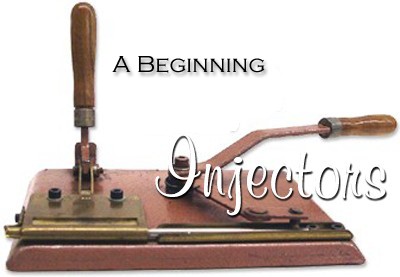
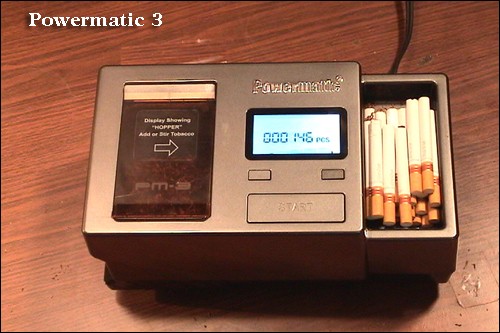
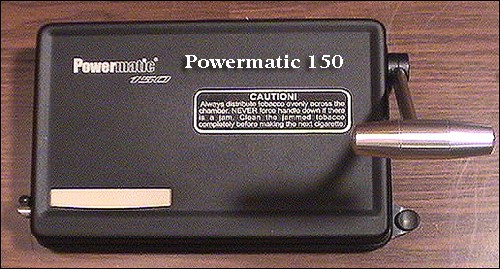
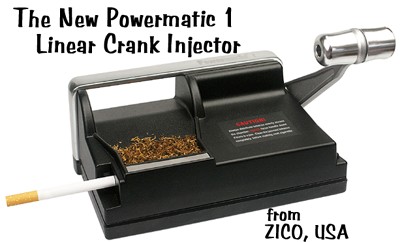 batch will still not satisfy the current demand, ZICO has
gone even further to provide an alternative. And what an alternative it is. This time with
the finest, most ergonomic, most advanced MANUAL crank injector ever
produced. Its name is the Powermatic I, and it is spectacular. Some have
already (June 1st) reached distributors and retailers with many more to come. This cranker
represents an exciting whole new strategy (finally) on manual injectors. It is stronger,
faster and most especially, easier to use both strategically and physically than any
injector we have EVER seen. Note"
As to the strength of any injector there are things we have repeatedly covered on the
subject over the many years that you will find under the thumbnail below that links you to
the video. Read "The Injector - The Realities", it is vital information!
batch will still not satisfy the current demand, ZICO has
gone even further to provide an alternative. And what an alternative it is. This time with
the finest, most ergonomic, most advanced MANUAL crank injector ever
produced. Its name is the Powermatic I, and it is spectacular. Some have
already (June 1st) reached distributors and retailers with many more to come. This cranker
represents an exciting whole new strategy (finally) on manual injectors. It is stronger,
faster and most especially, easier to use both strategically and physically than any
injector we have EVER seen. Note"
As to the strength of any injector there are things we have repeatedly covered on the
subject over the many years that you will find under the thumbnail below that links you to
the video. Read "The Injector - The Realities", it is vital information! 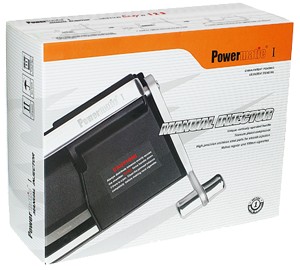 often like to make
a stick away from an electric plug. Both machines reflect ZICO'S intense
dedication to quality and consistency. And their service is the best in the rare situation
where something might go wrong. In other words they are easy to reach if a problem occurs
and very fast to react. ZICO, USA is a warm and very solid, efficient
company.
often like to make
a stick away from an electric plug. Both machines reflect ZICO'S intense
dedication to quality and consistency. And their service is the best in the rare situation
where something might go wrong. In other words they are easy to reach if a problem occurs
and very fast to react. ZICO, USA is a warm and very solid, efficient
company.
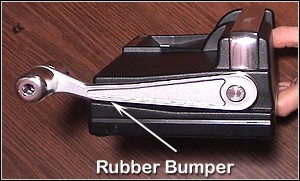 discussed in
the paragraph below "The Injector - The Realities". Also the travel of the crank
has been reduced so that it no longer hits the rubber dot cushion (referred to as the
bumper in the photos) if one really slams the handle down, as they are used to with the
typical circular motion crank injectors of older designs (Supermatic Top-O-Matic Excel,
etc.). The Powermatic 1 is so easy to crank (straight linear pull down) that when I read a
couple of comments at places like Amazon that were complaining that at the end of the
injecting process (motion), the crank would slam against the rubber bumper, it really
bugged me. There is absolutely no reason whatsoever to pull the crank hard or move it fast
as was necessary with most previous crankers mentioned above. In the video above we
show how easy this crank is to pull down. The weight of one's hand is almost all that is
needed and more importantly there is no speed requirement to make a good stick. You can
use a very leisurely pace when making sticks. Nonetheless Fan Bao (being the perfectionist
he is) felt some concern about a few of these comments and changed the throw (travel) of
the Powermatic 1 crank. The photo (left) shows the original we shot video of, (actually a
still from the video) where you can easily see that the handle (crank) when in the full
injection position, touches the rubber pad.
discussed in
the paragraph below "The Injector - The Realities". Also the travel of the crank
has been reduced so that it no longer hits the rubber dot cushion (referred to as the
bumper in the photos) if one really slams the handle down, as they are used to with the
typical circular motion crank injectors of older designs (Supermatic Top-O-Matic Excel,
etc.). The Powermatic 1 is so easy to crank (straight linear pull down) that when I read a
couple of comments at places like Amazon that were complaining that at the end of the
injecting process (motion), the crank would slam against the rubber bumper, it really
bugged me. There is absolutely no reason whatsoever to pull the crank hard or move it fast
as was necessary with most previous crankers mentioned above. In the video above we
show how easy this crank is to pull down. The weight of one's hand is almost all that is
needed and more importantly there is no speed requirement to make a good stick. You can
use a very leisurely pace when making sticks. Nonetheless Fan Bao (being the perfectionist
he is) felt some concern about a few of these comments and changed the throw (travel) of
the Powermatic 1 crank. The photo (left) shows the original we shot video of, (actually a
still from the video) where you can easily see that the handle (crank) when in the full
injection position, touches the rubber pad. 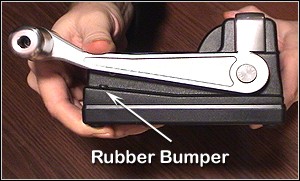 already smooth stroke end in an even softer
finish, with no contact with the bumper. So if with the new version, you are still hitting
the bumper, you are putting way too much down force on the handle as you inject. Remember
this highly precision machine does not need either a fast nor heavy pressure down stroke.
If you follow this advice and what you are to read below (as well as the general injector
advice at the very bottom of this page), it is almost impossible to comprehend damaging
it. This is one tough machine and with its unique, high precision, and smooth stroke, it
still gets our vote as the finest manual injector ever created. Now some simple logic.
already smooth stroke end in an even softer
finish, with no contact with the bumper. So if with the new version, you are still hitting
the bumper, you are putting way too much down force on the handle as you inject. Remember
this highly precision machine does not need either a fast nor heavy pressure down stroke.
If you follow this advice and what you are to read below (as well as the general injector
advice at the very bottom of this page), it is almost impossible to comprehend damaging
it. This is one tough machine and with its unique, high precision, and smooth stroke, it
still gets our vote as the finest manual injector ever created. Now some simple logic.
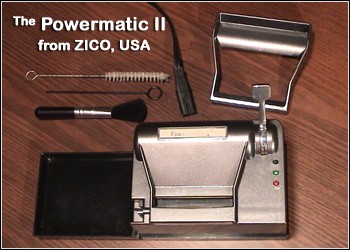
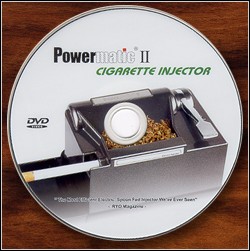 (longer than the year we beat it up) is likely going to be phenomenal. It
is seductively small, roughly a 5" cube (actually it measures 5.5"L x 3.8"H
x 4" D without tray which is easily removed) a great size for desktop and travel
both. And it has significant mass weighing in at a well built 2.25 pounds. It feels
weighty like all well built machines tend to feel. And it is quite beautiful as well. All
former problems have been cured, and the one shown in the video we have tested constantly
for nearly a year. The designer, Fan Bao, like most of the people in this industry that
have earned our ultimate respect, is a perfectionist. Even now he is continuing with minor
updates to the machine, although after our long and damn tough/thorough testing, we could
find NO further weaknesses.
(longer than the year we beat it up) is likely going to be phenomenal. It
is seductively small, roughly a 5" cube (actually it measures 5.5"L x 3.8"H
x 4" D without tray which is easily removed) a great size for desktop and travel
both. And it has significant mass weighing in at a well built 2.25 pounds. It feels
weighty like all well built machines tend to feel. And it is quite beautiful as well. All
former problems have been cured, and the one shown in the video we have tested constantly
for nearly a year. The designer, Fan Bao, like most of the people in this industry that
have earned our ultimate respect, is a perfectionist. Even now he is continuing with minor
updates to the machine, although after our long and damn tough/thorough testing, we could
find NO further weaknesses. 

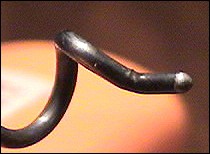
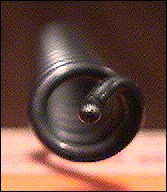
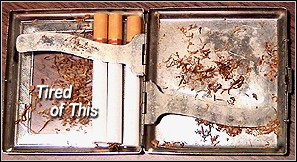
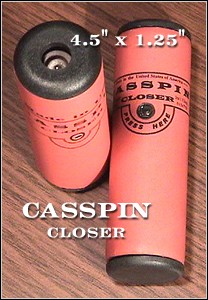
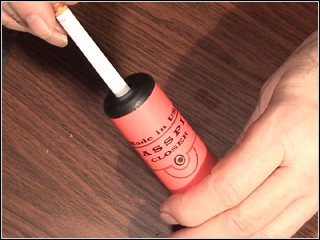 near the end of your supply of sticks, even in a very good case, one
begins to find increasing amounts of loose tobacco in the case, tobacco that should have
remained in the stick. Since the tobaccos most used in CMC are free from any binders or
adhesives to make the tobacco in tubes more sticky, this was a problem I assumed would
always persist. Usually when walking with the case in a pocket, I simply carried my case
filter tip down. That actually works to a degree but if the sticks have been in there very
long, even when you take them out, the tobacco has dried and will begin to fall out. Once
lit the tobacco becomes stable but you can loose a good amount in the meantime.
near the end of your supply of sticks, even in a very good case, one
begins to find increasing amounts of loose tobacco in the case, tobacco that should have
remained in the stick. Since the tobaccos most used in CMC are free from any binders or
adhesives to make the tobacco in tubes more sticky, this was a problem I assumed would
always persist. Usually when walking with the case in a pocket, I simply carried my case
filter tip down. That actually works to a degree but if the sticks have been in there very
long, even when you take them out, the tobacco has dried and will begin to fall out. Once
lit the tobacco becomes stable but you can loose a good amount in the meantime.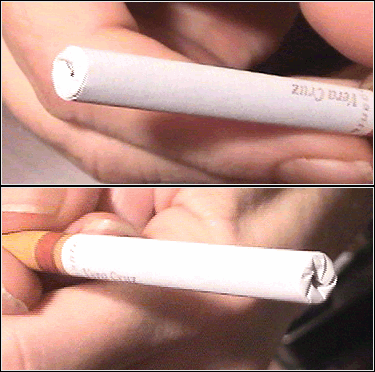 much too rare in our country and it hints quite strongly at perhaps the most
effective solution to our economic woes. Simply put, think of what you would like to be
able to buy to perform a specific function and if it does not exist, CREATE IT.
America has always been an extraordinarily creative society. Now Curt is a full time
engineer and did all of this in his spare time. The point is he made the time - as can we
all when we really want to. The world is full of product vacuums and vacuums prefer to be
filled. Really an inspiring example of what is possible with a little thinking, a little
effort and a knack for seeing beyond the obvious "what is" to the more esoteric
"what can or should be". So here we show you graphics of the CASSPIN CLOSER
later to be followed by a comprehensive video exploration of this ingenious device.
much too rare in our country and it hints quite strongly at perhaps the most
effective solution to our economic woes. Simply put, think of what you would like to be
able to buy to perform a specific function and if it does not exist, CREATE IT.
America has always been an extraordinarily creative society. Now Curt is a full time
engineer and did all of this in his spare time. The point is he made the time - as can we
all when we really want to. The world is full of product vacuums and vacuums prefer to be
filled. Really an inspiring example of what is possible with a little thinking, a little
effort and a knack for seeing beyond the obvious "what is" to the more esoteric
"what can or should be". So here we show you graphics of the CASSPIN CLOSER
later to be followed by a comprehensive video exploration of this ingenious device. 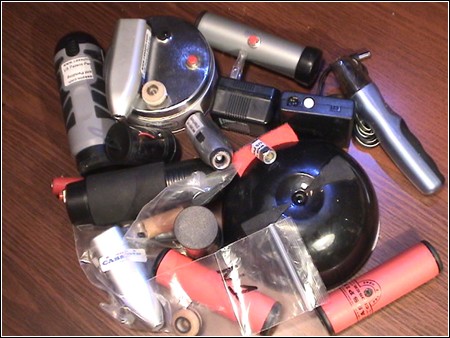
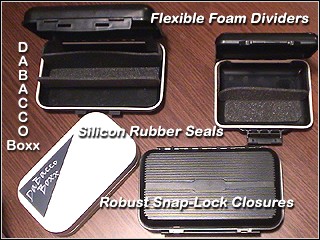
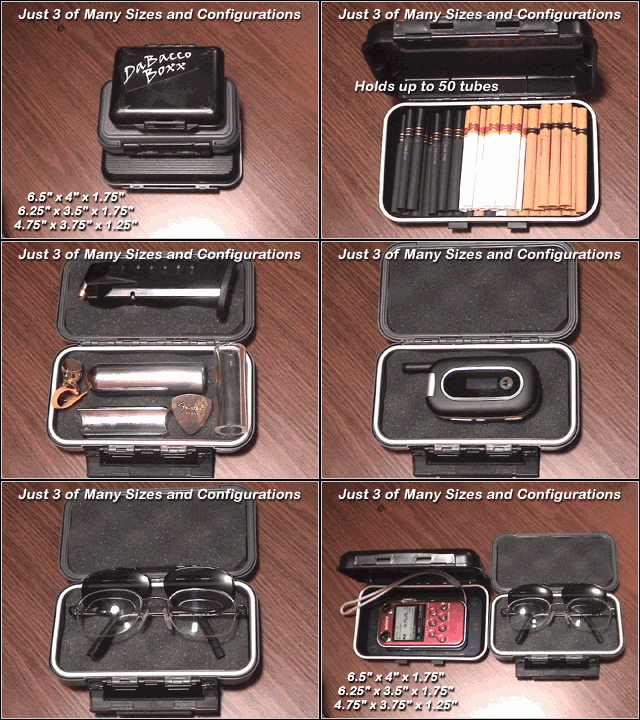 size. Carrying tubes around is one of the most
care intensive activity for the traveling RYO/MYO/CMC enthusiast. These boxes serve as
many functions as one can imagine, but for sensitive instruments (micrometers) and small
recorders, players, cell phone, and a host of other costly yet delicate items, these boxes
are a dream realized for the traveler.
size. Carrying tubes around is one of the most
care intensive activity for the traveling RYO/MYO/CMC enthusiast. These boxes serve as
many functions as one can imagine, but for sensitive instruments (micrometers) and small
recorders, players, cell phone, and a host of other costly yet delicate items, these boxes
are a dream realized for the traveler.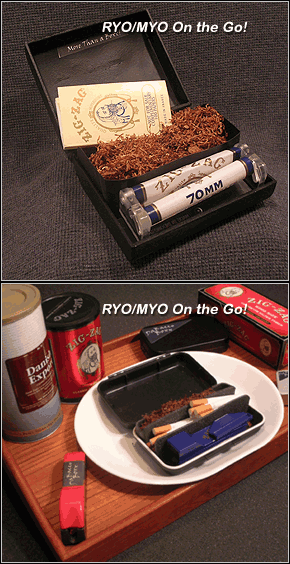 dozens of sizes and styles. I use them for just about everything I either have to pack or
in many cases, just want to safely transport in jacket pocket, golf bag, car, bike, or
suitcase. I love little boxes, always have but most are ungainly, ugly and less than
secure. Vega has overlooked nothing including boxes that provide near water proof
attributes, certainly water resistant. Keeps your tobacco dry, your tubes uncrushed, and,
again, almost anything else that needs such protection, extremely safe and secure. The
Silicon rubber seals are really tight and the closures are one of the best I've ever seen
at any price. Take a look at these - your gonna say to yourself, now "why didn't I
think of that myself?" Check them out by clicking
dozens of sizes and styles. I use them for just about everything I either have to pack or
in many cases, just want to safely transport in jacket pocket, golf bag, car, bike, or
suitcase. I love little boxes, always have but most are ungainly, ugly and less than
secure. Vega has overlooked nothing including boxes that provide near water proof
attributes, certainly water resistant. Keeps your tobacco dry, your tubes uncrushed, and,
again, almost anything else that needs such protection, extremely safe and secure. The
Silicon rubber seals are really tight and the closures are one of the best I've ever seen
at any price. Take a look at these - your gonna say to yourself, now "why didn't I
think of that myself?" Check them out by clicking 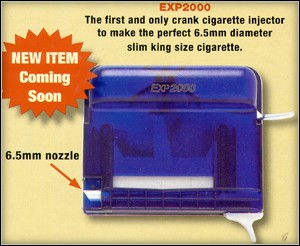 that time we have stressed quality and moderation over cost. We have
tested products from this industry in countries where packaged cigarettes cost LESS than
pure tobacco, if you can find it at all. In every case even extremely fiscally challenged
smokers realized the superior nature of a freshly injected stick, most profoundly when the
tobacco used was of the highest quality. They not only preferred this to their normal
brand of cigarettes but would go to great lengths to obtain it, even if it meant
significantly reduced consumption.
that time we have stressed quality and moderation over cost. We have
tested products from this industry in countries where packaged cigarettes cost LESS than
pure tobacco, if you can find it at all. In every case even extremely fiscally challenged
smokers realized the superior nature of a freshly injected stick, most profoundly when the
tobacco used was of the highest quality. They not only preferred this to their normal
brand of cigarettes but would go to great lengths to obtain it, even if it meant
significantly reduced consumption. 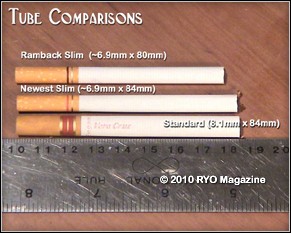 However, what we speak of now is the encore of this great little machine.
Yes, the EXP2000. It is a true crankstyle SLIM tube injector. That's
right, the slim 6.5mm/6.9mm tube that CTC (Supermatic pre Imperial buyout) experimented
with several years ago. The Premier Slim had problems. First and most important of all was
that no tubes were available separately. You had to buy the tubes in a kit form that
included the injector. Actually it was not all that bad of an idea as the bundled hand
injector was so weak that a couple of boxes of tubes could likely wear it out. Even though
the slim injector and tubes soon disappeared, there remained quite a number of folks who
loved the size. People all over the world struggled to get tubes for their funky little
injector.
However, what we speak of now is the encore of this great little machine.
Yes, the EXP2000. It is a true crankstyle SLIM tube injector. That's
right, the slim 6.5mm/6.9mm tube that CTC (Supermatic pre Imperial buyout) experimented
with several years ago. The Premier Slim had problems. First and most important of all was
that no tubes were available separately. You had to buy the tubes in a kit form that
included the injector. Actually it was not all that bad of an idea as the bundled hand
injector was so weak that a couple of boxes of tubes could likely wear it out. Even though
the slim injector and tubes soon disappeared, there remained quite a number of folks who
loved the size. People all over the world struggled to get tubes for their funky little
injector.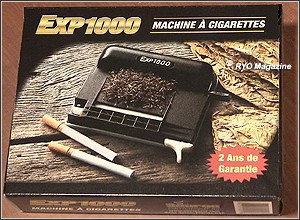 Simron International now makes this machine. The same family has been
involved with it from the beginning (mid 60s). It carried the name the Corona Cigarette
Machine in the very early 70s and was extremely successful in Canada for more than a
decade as such. In the 80s. RJR - MacDonald (the Canadian division of RJR) licensed the
design (in reality it continued to be made by the same folks but was renamed the EXP1000).
Again, this machine apparently flourished in Canada for some time after that but got
almost no attention in the US. Even with sales exceeding a million units over the period,
for more than 10 years it has been out of production. However, the man whose family
started the Canada-based Orleans International and who worked for the company from the age
of 13 has once again begun production. Ron Moscovitch is his name. It's a
name you will hear a lot here in the future. Ron is our kind of guy, a man with vision and
with an extremely well combined sense of quality and logic. First though, a bit more
background.
Simron International now makes this machine. The same family has been
involved with it from the beginning (mid 60s). It carried the name the Corona Cigarette
Machine in the very early 70s and was extremely successful in Canada for more than a
decade as such. In the 80s. RJR - MacDonald (the Canadian division of RJR) licensed the
design (in reality it continued to be made by the same folks but was renamed the EXP1000).
Again, this machine apparently flourished in Canada for some time after that but got
almost no attention in the US. Even with sales exceeding a million units over the period,
for more than 10 years it has been out of production. However, the man whose family
started the Canada-based Orleans International and who worked for the company from the age
of 13 has once again begun production. Ron Moscovitch is his name. It's a
name you will hear a lot here in the future. Ron is our kind of guy, a man with vision and
with an extremely well combined sense of quality and logic. First though, a bit more
background.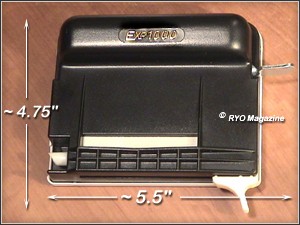 was once on the market. We just missed it. It had
disappeared before I found my first Supermatic in 1996 and was never really available in
the US anyway. There will be much more background later on Ron and the history of this
machine. However, it is time to first justify my statement above: "what
may likely become the most successful single design in injector history."
was once on the market. We just missed it. It had
disappeared before I found my first Supermatic in 1996 and was never really available in
the US anyway. There will be much more background later on Ron and the history of this
machine. However, it is time to first justify my statement above: "what
may likely become the most successful single design in injector history."
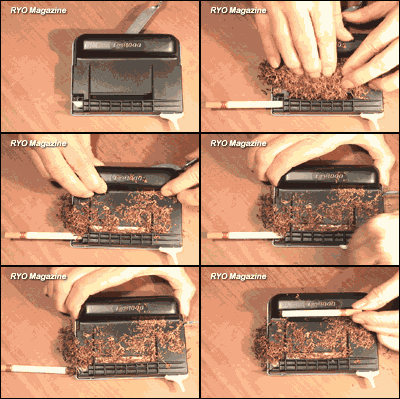 both the big Blue Supermatic and the
Top-O-Matic, as well as our continuing love affair with the Excel, one might wonder why we
rave about yet another injector. The EXP1000 is special in that it does not compete
directly with any of these machines. In other words, whether you have a TOP, Super, Excel,
or Magnum, you simply must have one of the EXPs. Pretty serious hype you
may think, but let me tell you why.
both the big Blue Supermatic and the
Top-O-Matic, as well as our continuing love affair with the Excel, one might wonder why we
rave about yet another injector. The EXP1000 is special in that it does not compete
directly with any of these machines. In other words, whether you have a TOP, Super, Excel,
or Magnum, you simply must have one of the EXPs. Pretty serious hype you
may think, but let me tell you why. 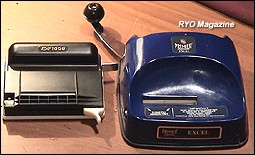 price as the Magnum. You would
never be stuck for lack of a machine. The Magnum and the EXP1000 are both ingenious
designs. Both will do 100s as well as Kings or shorter (as will the Supermatic and
Top-O-Matic). In fact, all of the great injectors we recommend here are studies in
ingenuity. However, no matter which one you prefer, the EXP1000 will grace the tobacco
tables of nearly every injector owner. It comes with a TWO year warranty and fits in a
coat pocket. The nozzles have been wisely reduced in size (following our constant urging
for the whole injector industry to do this) such that even undersized (within reason)
tubes fit nicely.
price as the Magnum. You would
never be stuck for lack of a machine. The Magnum and the EXP1000 are both ingenious
designs. Both will do 100s as well as Kings or shorter (as will the Supermatic and
Top-O-Matic). In fact, all of the great injectors we recommend here are studies in
ingenuity. However, no matter which one you prefer, the EXP1000 will grace the tobacco
tables of nearly every injector owner. It comes with a TWO year warranty and fits in a
coat pocket. The nozzles have been wisely reduced in size (following our constant urging
for the whole injector industry to do this) such that even undersized (within reason)
tubes fit nicely.


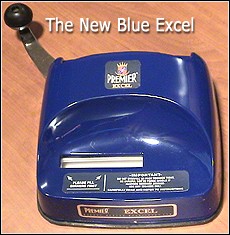 outstanding. The newest Top-O-Matic may be the most
robust, smoothest working crank injector we have seen. The very newest Premier Supermatic
is right there with it. What follows is our analysis of the significant improvements to
these two machines.
outstanding. The newest Top-O-Matic may be the most
robust, smoothest working crank injector we have seen. The very newest Premier Supermatic
is right there with it. What follows is our analysis of the significant improvements to
these two machines.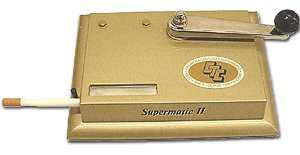 detail follows on these top
performers and their verified latest upgrades, but first . . .
detail follows on these top
performers and their verified latest upgrades, but first . . .
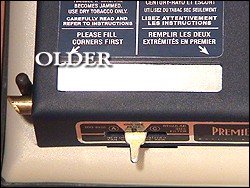 longer in the stick. This is no doubt why he has more problems with the Excel but would
likely have a similar experience even with the big metal cranks.
longer in the stick. This is no doubt why he has more problems with the Excel but would
likely have a similar experience even with the big metal cranks. 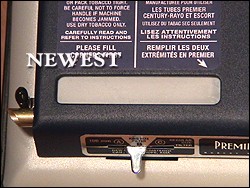 That is until now. And this is the tag line for what follows.
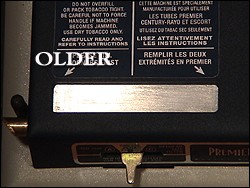 improvements. The Supermatic has been outstanding for a long time. However,
as is often the case in this industry, money and effort is expended to make better
products because it is the right thing to do. Perhaps the existence of the Top-O-Matic was
a bit of an incentive to do so, but it is my take that the folks at RBA and Imperial take
great pride in making the best products possible and are willing to allocate the resources
necessary to accomplish this. And of course with these new design elements, the repair
frequency and thus after costs should be significantly reduced. This new Premier machine
is the finest, by a good margin, ever produced in this brand line.
improvements. The Supermatic has been outstanding for a long time. However,
as is often the case in this industry, money and effort is expended to make better
products because it is the right thing to do. Perhaps the existence of the Top-O-Matic was
a bit of an incentive to do so, but it is my take that the folks at RBA and Imperial take
great pride in making the best products possible and are willing to allocate the resources
necessary to accomplish this. And of course with these new design elements, the repair
frequency and thus after costs should be significantly reduced. This new Premier machine
is the finest, by a good margin, ever produced in this brand line. 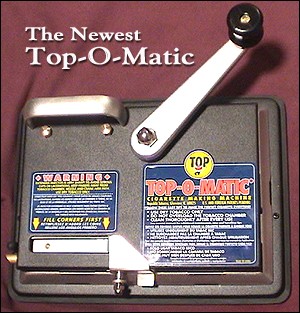 after the show, Republic called me to ask if I had
seen the new model. I told them I heard it now had a handle to hold on to (that some
people who called me after the show thought looked a bit gaudy) but other than that I had
not heard any real detail. They sent me one immediately. I'm not sure what I expected as
the TOP machine was nearly a clone of the Supermatic from its start. It was always a bit
taller and easier for my large hands to hold on to, it was heavier and with some
recommended changes (nozzle size and return spring tension), the first TOP-O-Matic was
already a worthy entry. I hate comparing similar products in reviews as there will always
be those who ask, which one is best? It is hard to answer questions like that when two
machines are so similar and user's actions with the machines are so varied. They both were
good and our readers agreed. Some liked one better than the other but there was never
anything close to a consensus.
after the show, Republic called me to ask if I had
seen the new model. I told them I heard it now had a handle to hold on to (that some
people who called me after the show thought looked a bit gaudy) but other than that I had
not heard any real detail. They sent me one immediately. I'm not sure what I expected as
the TOP machine was nearly a clone of the Supermatic from its start. It was always a bit
taller and easier for my large hands to hold on to, it was heavier and with some
recommended changes (nozzle size and return spring tension), the first TOP-O-Matic was
already a worthy entry. I hate comparing similar products in reviews as there will always
be those who ask, which one is best? It is hard to answer questions like that when two
machines are so similar and user's actions with the machines are so varied. They both were
good and our readers agreed. Some liked one better than the other but there was never
anything close to a consensus. 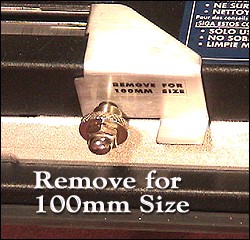 the tube; tight all the way to the filter plug. And by
doing that, the entire stick packs more firmly and evenly on both machines. This is a
stunning development in injectors. It will make those new to the method more quickly
successful and save us old timers a lot of wrist work and explanations of what is indeed
an art, not a science - tapping. While the spoons on both of these injectors show some
slight changes, it is the heavily enhanced internals and improved cutters that produce
this magic.
the tube; tight all the way to the filter plug. And by
doing that, the entire stick packs more firmly and evenly on both machines. This is a
stunning development in injectors. It will make those new to the method more quickly
successful and save us old timers a lot of wrist work and explanations of what is indeed
an art, not a science - tapping. While the spoons on both of these injectors show some
slight changes, it is the heavily enhanced internals and improved cutters that produce
this magic. 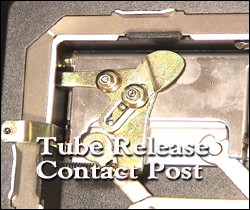 easily loosened knurled knob that secures the insert in place. This insert must be placed
precisely in its correct position for the cutter to move forward (for King Size), but this
is very simple. And again, the rubber bottom mat that has been a plus on the Top machine
since its inception remains very plush.
easily loosened knurled knob that secures the insert in place. This insert must be placed
precisely in its correct position for the cutter to move forward (for King Size), but this
is very simple. And again, the rubber bottom mat that has been a plus on the Top machine
since its inception remains very plush.  to this genius and valued friend in our Review Section in the next couple of
weeks) pretty much created the platform that transformed the original LaFrancaise French
injector to the path of its current design, the Supermatic. His father first brought it in
to North America but Arnold's engineering powers really got this whole industry going.
There has been no greater pivotal influence on MYO/CMC than Arnold Kastner - period.
to this genius and valued friend in our Review Section in the next couple of
weeks) pretty much created the platform that transformed the original LaFrancaise French
injector to the path of its current design, the Supermatic. His father first brought it in
to North America but Arnold's engineering powers really got this whole industry going.
There has been no greater pivotal influence on MYO/CMC than Arnold Kastner - period.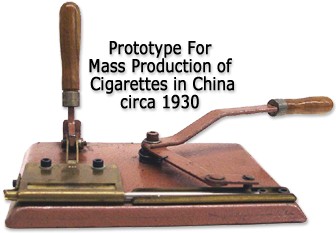 elements of injector design that seemed to me rather dated or at least
pretty staid. The first was the spoon and the second was the strategy of one motion
injection. Some of Arnold's earlier designs for mass producing cigarettes by cheap labor
in China were units that had a separate compression stroke. The injection stroke was a
separate operation as well and by separating these two functions, a much more robust
machine could be built. Millions of cigarettes we made by workers using these machines (at
right) and put into packs. Arnold told me that this was in the late 30s. Most everything,
especially the compression stroke, worked in one plane, in other words a straight line.
Because the compression is the most energy intensive part of injecting, his machine, a
single stroke, allowed one to compress the tobacco incredibly well. In fact, you could
crush nearly anything in this vice like design. The injection stroke was a simplified dual
lever (more like an Excel) but had great strength and leverage as well. However, what we
focused on, given that the compression stroke was easily accomplished from a design
standpoint, was why not make the injection part of the system a straight line as well.
Even more to the point, why not make the already tightly and accurately compressed roll of
tobacco (if you will) the only thing that enters the tube. No spoon to take up space as it
carries the tobacco into the tube - no spoon to drag out some of the tobacco as it leaves
the tube. Simply a push rod to smoothly push the tight tobacco roll such that the tube
would not begin to release until the tobacco itself was tightly compressed against the
filter plug.
elements of injector design that seemed to me rather dated or at least
pretty staid. The first was the spoon and the second was the strategy of one motion
injection. Some of Arnold's earlier designs for mass producing cigarettes by cheap labor
in China were units that had a separate compression stroke. The injection stroke was a
separate operation as well and by separating these two functions, a much more robust
machine could be built. Millions of cigarettes we made by workers using these machines (at
right) and put into packs. Arnold told me that this was in the late 30s. Most everything,
especially the compression stroke, worked in one plane, in other words a straight line.
Because the compression is the most energy intensive part of injecting, his machine, a
single stroke, allowed one to compress the tobacco incredibly well. In fact, you could
crush nearly anything in this vice like design. The injection stroke was a simplified dual
lever (more like an Excel) but had great strength and leverage as well. However, what we
focused on, given that the compression stroke was easily accomplished from a design
standpoint, was why not make the injection part of the system a straight line as well.
Even more to the point, why not make the already tightly and accurately compressed roll of
tobacco (if you will) the only thing that enters the tube. No spoon to take up space as it
carries the tobacco into the tube - no spoon to drag out some of the tobacco as it leaves
the tube. Simply a push rod to smoothly push the tight tobacco roll such that the tube
would not begin to release until the tobacco itself was tightly compressed against the
filter plug. 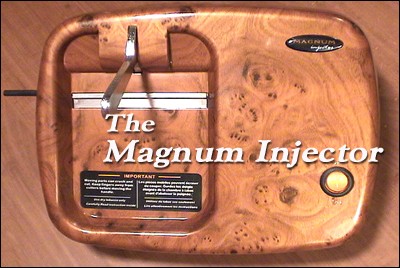 The
man who so patiently waited for me was Luigi Derose. He and his partners - some of whom
were evidently designers or engineers for CTC, had come up with a design (after several
years of hard work) that I was about to see. Again I remained skeptical, that is until he
made the first stick. What resulted may change this industry forever. A perfect, very hard
packed cigarette (really firm just like a manufactured cigarette) that needed no tapping -
none! In fact the machine's design is so innovative that the excess tobacco, if you over
fill the chamber, sticks out of the tube so firmly that cutting it with scissors is simple
and very precise.
The
man who so patiently waited for me was Luigi Derose. He and his partners - some of whom
were evidently designers or engineers for CTC, had come up with a design (after several
years of hard work) that I was about to see. Again I remained skeptical, that is until he
made the first stick. What resulted may change this industry forever. A perfect, very hard
packed cigarette (really firm just like a manufactured cigarette) that needed no tapping -
none! In fact the machine's design is so innovative that the excess tobacco, if you over
fill the chamber, sticks out of the tube so firmly that cutting it with scissors is simple
and very precise. 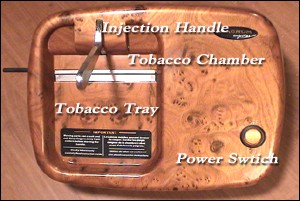 plug it in. The designers claim at least 7 cartons (1400 sticks on one
recharge - not all at once) but I got a hell of a lot more than that over quite a few
days. In fact, the only time I recharged it (besides briefly plugging it in to test the
power supply - wall-wart type) was when I finally had to send it back. I had it for nearly
a month. So lets look at some graphics and then you can watch the videos of the Magnum in
the MultiMedia Injector section if you have the bandwidth.
plug it in. The designers claim at least 7 cartons (1400 sticks on one
recharge - not all at once) but I got a hell of a lot more than that over quite a few
days. In fact, the only time I recharged it (besides briefly plugging it in to test the
power supply - wall-wart type) was when I finally had to send it back. I had it for nearly
a month. So lets look at some graphics and then you can watch the videos of the Magnum in
the MultiMedia Injector section if you have the bandwidth. 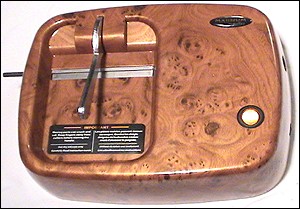 result of this is that one need not pack down the
tobacco firmly at all. Simply distribute over the length of the chamber, push it down
lightly, and as much tobacco (after compaction) is pushed until the tobacco roll hits the
filter element and begin to push the tube off the machine. This is the design I always
envisioned and I am really gratified that it works. So its not my design. I don't care. It
is what I wanted and the folks who made it are far more gifted in actual mechanical
engineering and construction than am I.
result of this is that one need not pack down the
tobacco firmly at all. Simply distribute over the length of the chamber, push it down
lightly, and as much tobacco (after compaction) is pushed until the tobacco roll hits the
filter element and begin to push the tube off the machine. This is the design I always
envisioned and I am really gratified that it works. So its not my design. I don't care. It
is what I wanted and the folks who made it are far more gifted in actual mechanical
engineering and construction than am I. 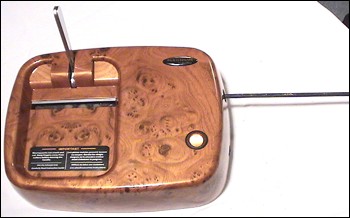 another injection one
only needs to push the handle up and away and the motor engages to drive the rod back into
its starting position. (See at right). Now it is at this stage that the machine is in its
most vulnerable position as the rod sticks out quite a bit to the right. The length of
this rod is one of the secrets to this machine's success at filling any length tube. After
the injecting session is over simply closing the lever (towards you) which brings the rod
to the first shown position (again above left) and turning the machine off allows for very
safe storage. Yes, the rod still extends a bit but this is a very tough rod, 21st century
materials all the way.
another injection one
only needs to push the handle up and away and the motor engages to drive the rod back into
its starting position. (See at right). Now it is at this stage that the machine is in its
most vulnerable position as the rod sticks out quite a bit to the right. The length of
this rod is one of the secrets to this machine's success at filling any length tube. After
the injecting session is over simply closing the lever (towards you) which brings the rod
to the first shown position (again above left) and turning the machine off allows for very
safe storage. Yes, the rod still extends a bit but this is a very tough rod, 21st century
materials all the way. 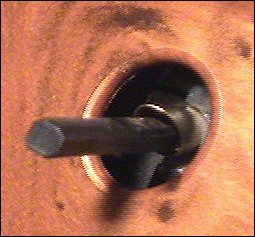 with my right hand was hard
(using the standard position that I would use with a normal injector), but obviously one
can turn the machine at any angle to use it best. And though the Magnum compression phase
does compress the tobacco quite a bit, an equal amount of compression occurs as the
tobacco enters the tube. Again tobacco is all that enters the tube. The rod never reaches
into it. Compression is assured to whatever setting you wish. Other electrics claim
adjustments for this but I've yet to see one where the adjustment really works very well,
if at all, which is the least of their problems. With this machine, due mostly to
its simple and straightforward design (literally everything works in a straight line -
just like Arnold and I supposed) minor adjustments are simple and highly effective.
with my right hand was hard
(using the standard position that I would use with a normal injector), but obviously one
can turn the machine at any angle to use it best. And though the Magnum compression phase
does compress the tobacco quite a bit, an equal amount of compression occurs as the
tobacco enters the tube. Again tobacco is all that enters the tube. The rod never reaches
into it. Compression is assured to whatever setting you wish. Other electrics claim
adjustments for this but I've yet to see one where the adjustment really works very well,
if at all, which is the least of their problems. With this machine, due mostly to
its simple and straightforward design (literally everything works in a straight line -
just like Arnold and I supposed) minor adjustments are simple and highly effective. 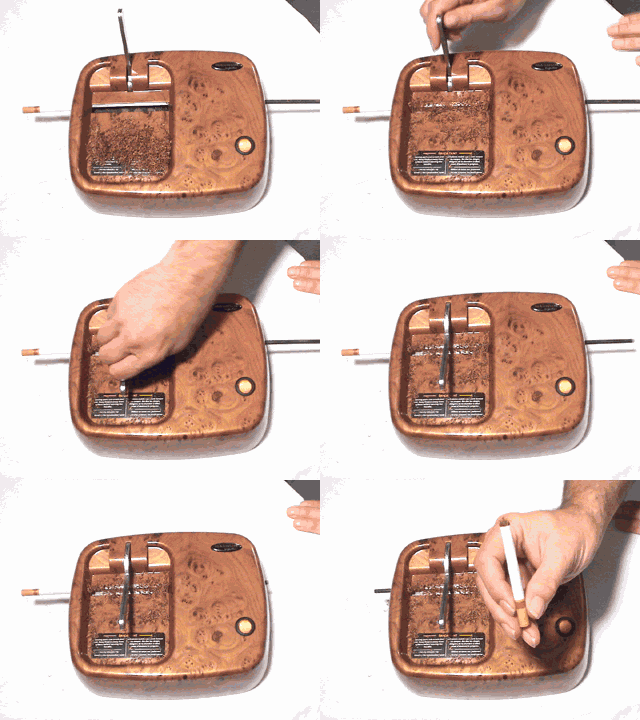 make it very easy (though I've recommended the maker reduce its
size a bit more to make tube fitting even faster). And you have to sweep tobacco each time
into the chamber but this is a very easy task as packing down of the tobacco is only
minimally necessary. Not having to tap down the finished stick saves a whole lot of time
and before you realize it you have a whole days worth of smoking pleasure. And the smokes
I took in my case did not lose one bit of tobacco as I bumped around the course. For those
of you without broadband connections we show you here a rough animation so you can get a
basic idea of how this machine works. Keep in mind that the stick you are seeing made at
right is no illusion. No tricks here. The stick is a firm as any manufactured cigarette
with no soft spots anywhere along its length. I made it just a tidge too long so I could
cut it off neatly. My way!
make it very easy (though I've recommended the maker reduce its
size a bit more to make tube fitting even faster). And you have to sweep tobacco each time
into the chamber but this is a very easy task as packing down of the tobacco is only
minimally necessary. Not having to tap down the finished stick saves a whole lot of time
and before you realize it you have a whole days worth of smoking pleasure. And the smokes
I took in my case did not lose one bit of tobacco as I bumped around the course. For those
of you without broadband connections we show you here a rough animation so you can get a
basic idea of how this machine works. Keep in mind that the stick you are seeing made at
right is no illusion. No tricks here. The stick is a firm as any manufactured cigarette
with no soft spots anywhere along its length. I made it just a tidge too long so I could
cut it off neatly. My way!